What's new?

Read Blog

Call for papers for next year’s ECPR general conference

For this year’s general conference of the ECPR in Reykjavik Darren Lilleker [@DrDGL] from the University of Bournemouth and I are hosting a panel on uses of social media in political campaigns. If you are interested in this topic and have some work done on it please consider reacting to this call for papers:

Supporter Networks, Blogs, Tweets, and YouTube Videos: Political Campaigns Online

Social media tools have become common features in election campaigns around the world. Still, their adoption varies from country to country and campaign to campaign. This offers a valuable opportunity for researchers interested in political communication and political campaigns. Campaigns exist in specific political, cultural and technological contexts. These contexts determine the way political actors use social media tools in their campaigns. By comparing online campaigns in different countries and of different political leanings we can learn more about the nature of political communication online independent of specific local contexts. To this end the panel “Supporter Networks, Blogs, Tweets, and YouTube Videos: Political Campaigns Online” invites papers that examine recent political campaigns and their use of online channels and social media tools in their specific political, cultural or technological contexts. Questions that might be addressed are: Which social media tools did the campaign in question choose to use and why? How were these decisions grounded, in specific local contexts or advice from international campaigning professionals? Did the campaign achieve its goals and how was this evaluated? From a methodological perspective we are open to different approaches, be it in the form of qualitative case studies, quantitative analysis or work based on the digital methods approach. Also we invite papers that connect specific campaigns to concepts from communication theory, be it for example a discussion in the context of professionalization, mobilization, the digital divide or political learning.

“Social Media in political campaigns in Germany” at #pdfeu

Damn, Barcelona is hard to leave! This year’s Personal Democracy Forum Europe again took place in Barcelona, which in early autumn is a wonderful place to be. I just returned from there to the more central European version of autumn here in Germany. This post is not to reflect on the whole PDF EU experience, this will have to wait for a later time, but to briefly sketch the panel I was involved in.

The panel was called “Online Political Organizing in Regional and Local Campaigns” and moderated by Antonella Napolitano [@svaroschi]. With Nicolas Vanbremeersch [@versac] from France, Dino Amenduni [@doonie] from Italy, and Lluis Recorder [@lluisrecoder] from Spain we discussed short case studies in which we tried to illustrate the potential of social media for campaigns on a regional or local level.

Nicolas talked about his experiences using social media to facilitate closer contact between citizens and regional branches of the French government. Dino talked about the highly media centered campaigns he did with the Italian agency Proforma for two Italian politicians, Michele Emiliano and Nichi Vendola. Lluís Recorder, mayor of Sant Cugat del Vallès, talked about his experiences in using social media channels and their influence on his governing practice. These talks were highly stimulating and the presented cases illustrated the potential of social media in different European and political contexts. If you are interested there is an audio recording of the panel available on the PDF Europe site.

On the panel I talked about the social media elements in three recent CDU campaigns – Hessen 2009, the general election 2009 and Nordrhein-Westfalen 2010. In the presentation I tried to highlight the continuity between the campaigns, which exemplify an interesting cycle of campaign learning that build on the lessons of the preceding campaigns. As my presentation design focuses on visuals I hope the recording of the panel gives you the context you need for the slides above.

[Update: 2010/10/15]
Antonella Napolitano has posted a written a little wrap up on the session on the PDF Europe blog: From PdF Europe 2010: Online Political Organizing in Regional and Local Campaigns.

Traveling the Spanish Speaking World. Well, Sort of…

A few weeks ago I gave a written interview to Karina Gómez from the Spanish news agency EFE on the potential uses of Twitter for political activists. Some snippets of this interview now make the rounds through the Spanish speaking web, which is fun to watch:

It started on 27 August with “Redes sociales, escaparate polí­tico” by Karina Gómez Pernas in the Mexican publication Vanguardia, moved to Panama on September 5 as “¿Escaparate político?” on the site prensa.com. Then on September 12 the item makes its rounds to Argentina on the website “Democracia.com” and is on the same day published in Spain. Only to appear on September 13 in Ecuador “Redes Sociales, escaparate político” on Pichincha al Día. Finally on September 18 the item appears in Brasil as “1ª Edition – Twitter: ferramenta tem papel importante para as democracias”.

Seems I’m running out of excuses to travel the Spanish speaking world.

[Update: 2010/09/22]
The item appeared also here:
“Redes sociales, escaparate político” at El Sol Online (Argentino)
“Las redes sociales, un escaparate político” at Prodigy MSN (Spain)

Political Communication Winter Term 2010-11 – Syllabus

It’s this time of year again. The winter term is just about to start and so I had a look at the seminar I’m about to give in the coming months and revised it a bit. I’ll be teaching an introductory course in political communication for first and second year students of political science at Bamberg University. The aim of the course is to familiarize students with some of the major theories and topics of political communication. Below you find a draft of the syllabus with the assigned readings. It would be great to know what you guys think of the syllabus and especially if in your opinion I am missing crucial elements that an introductory course in political communication should have.

General Readings
Denis McQuail. 2010. “News Public Opinion and Political Communication,” in: McQuail’s Mass Communication Theory. 6. Auflage. London: Sage, 503-536.

Donald R. Kinder. 2003. “Communication and Politics in the Age of Information,” in: David O. Sears, Leonie Huddy and Robert Jervis (eds.). Oxford Handbook of Political Psychology. New York: Oxford University Press, 357-393.

Holli A. Semetko. 2004. “Media, Public Opinion, and Political Action,” in: John D. H. Downing, Denis McQuail, Philip Schlesinger and Ellen Wartella (eds.). The Sage Handbook of Media Studies. Thousand Oaks, CA: Sage, 351-374.

Winfried Schulz. 2008. Politische Kommunikation: Theoretische Ansätze und Ergebnisse empirischer Forschung. 2. Auflage. Wiesbaden: VS Verlag für Sozialwissenschaften.

Introduction
Werner J. Severin and James W. Tankard. 1992. “Scientific Method,” in: Communication Theories: Origins, Methods, and Uses in the Mass Media. 3. Auflage. New York: Longman, 19-35.

Werner J. Severin and James W. Tankard. 1992. “Effects of Mass Communication,” in: Communication Theories: Origins, Methods, and Uses in the Mass Media. 3. Auflage. New York: Longman, 247-268.

Strong Media Effects and Propaganda
Mandatory Reading:
Paul F. Lazarsfeld and Robert K. Merton. 1949. “Studies in Radio and Film Propaganda,” Transactions of the New York Academy of Sciences 6, 58-79. Reprinted in: Robert K. Merton (ed.). 1968. Social Theory and Social Structure. New York: Free Press, 563-582.

Presentation on:
Klaus Merten. 2000. “Struktur und Funktion von Propaganda,” Publizistik 45 (2), 143-162.

Opinion Leaders and Two-Step-Flow of Communication

Mandatory Reading:
Paul F. Lazarsfeld, Bernard Berelson and Hazel Gaudet. 1944. “The Nature of Political Influence,” in: The People’s Choice: How the Voter Makes Up His Mind in a Presidential Campaign. New York: Duell Sloan and Pearce, 150-158.

Steven H. Chaffee and John L. Hochheimer. 1982. “The Beginnings of Political Communication Research in the US: Origins of the Limited Effects Model”, in: Everett M. Rogers and Francis Balle (eds.). The Media Revolution in America and Western Europe. Norwood, NJ: Ablex, 263-283.

Presentation on:
John P. Robinson. 1976. Interpersonal Influence in Election Campaigns: Two Step-Flow Hypotheses. Public Opinion Quarterly 40 (3), 304-319.

Minimal Effects: Reinforcement and Slectivity

Mandatory Reading:
Paul F. Lazarsfeld, Bernard Berelson and Hazel Gaudet. 1944. “The Types of Changes,” in: The People’s Choice: How the Voter Makes Up His Mind in a Presidential Campaign. New York: Duell Sloan and Pearce, 65-104.

David O. Sears and Jonathan L. Freedman. 1965. “Selective Exposure to Information: A Critical Review,” Public Opinion Quarterly 31 (2), 194-213.

Presentation on:
Natalie Jomini Stroud. 2008. “Media Use and Political Predispositions: Revisiting the Concept of Selective Exposure,” Political Behavior 30 (3), 341-366.

Shanto Iyengar and Kyu S. Hahn. 2009. “Red Media, Blue Media: Evidence of Ideological Selectivity in Media Use,” Journal of Communication 59 (1), 19-39.

Return to the Concept of Powerful Mass Media: Spiral of Silence

Mandatory Reading:
Elisabeth Noelle-Neumann. 1991. “The Theory of Public Opinion: The Concept of the Spiral of Silence,” in: James A. Anderson (ed.). Communication Yearbook 14. Newbury Park, CA: Sage, 256-287.

Serge Moscovici. 1991. “Silent Majorities and Loud Minorities,” in: James A. Anderson (ed.). Communication Yearbook 14. Newbury Park, CA: Sage, 298-308.

Presentation on:
Diana C. Mutz and Joe Soss. 1997. “Reading Public Opinion: The Influence of News Coverage on Perceptions of Public Sentiment,” Public Opinion Quarterly 61 (3), 431-451.

Carroll J. Glynn, Andrew F. Hayes, James Shanahan [@JamesShanahan]. 1997. “Perceived Support for One’s Opinion and Willingness to Speak Out,” Public Opinion Quarterly 61 (3), 452-463.

Agenda Setting and Priming

Mandatory Reading:
Maxwell E. McCombs and Donald L. Shaw. 1972. “The Agenda-Setting Function of Mass Media,” Public Opinion Quarterly 36 (2), 176-187.

Shanto Iyengar and Donald R. Kinder. 1987. “A Primordial Power?” in: News that Matters: Television and American Opinion. Chicago: The University of Chicago Press, 1-5.

Shanto Iyengar and Donald R. Kinder. 1987. “The Priming Effect,” in: News that Matters: Television and American Opinion. Chicago: The University of Chicago Press, 63-72.

Presentation on:
Lutz Erbring, Edie N. Goldenberg and Arthur H. Miller. 1980. “Front-Page News and Real-World Cues: A New Look at Agenda-Setting by the Media,” American Journal of Political Science 24 (1), 16-49.

Steven H. Chaffee and Miriam J. Metzger. 2001. “The End of Mass Communication?” Mass Communication and Society 4 (4), 365-79.

Framing

Mandatory Reading:
Dennis Chong and James N. Druckman. 2007. “Framing Theory,” Annual Review of Political Science 10, 103-126.

Robert M. Entman. 1993. “Framing: Toward Clarification of a Fractured Paradigm,” Journal of Communication 43 (4), 51-58.

Presentation on:
James N. Druckman. 2004. “Political Preference Formation: Competition, Deliberation, and the (Ir)relevance of Framing Effects,” American Political Science Review 98 (4), 671-686.

Dietram A. Scheufele [Blog] [@dietram] and David Tewksbury. 2007. “Framing, Agenda-Setting, and Priming: The Evolution of Three Media-Effects Models,” Journal of Communication 57 (1), 9-20.

Knowledge Gap and Digital Divide

Mandatory Reading:
Philip J. Tichenor, George A. Donohue and Clarice N. Olien. 1970. “Mass Media Flow and Differential Growth in Knowledge,” Public Opinion Quarterly 34 (2), 159-170.

Pippa Norris [Blog]. 2001. “Civic Engagement,” in: Digital Divide: Civic Engagement, Information Poverty, and the Internet Worldwide. Cambridge: Cambridge University Press, 217-232.

Presentation on:
Cecilie Gaziano. 1997. “Forecast 2000: Widening Knowledge Gaps,” Journalism and Mass Communication Quarterly 74 (2), 237-264.

Eszter Hargiatti [Blog] [@eszter] and Amanda Hinnant. 2008. “Digital Inequality: Differences in Young Adults’ Use of the Internet,” Communication Research 35 (5), 600-621.

The Selection of News and the Construction of Reality

Mandatory Reading:
Hans Mathias Kepplinger. 1989. “Theorien der Nachrichtenauswahl als Theorien der Realität,” Aus Politik und Zeitgeschichte, B15, 3-16.

W. Lance Bennett. 1990. “Towards a Theory of Press-State Relations in the United States,” Journal of Communication 40 (2), 103-125.

Presentation on:
W. Lance Bennett, Victor W. Pickard, David P. Iozzi, Carl L. Schroeder, Taso Lago and C. Evans Caswell. 2004. “Managing the Public Sphere: Journalistic Constructions of the Great Globalization Debate,” Journal of Communication 54 (3), 437-455.

Harvey Molotch and Marily J. Lester. 1974. “News as Purposive Behavior: On the Strategic Use of Routine Events, Accidents, and Scandals,” American Sociological Review 39 (1), 101-112.

Mass Media and Politics

Mandatory Reading:
Winfried Schultz. 2004. “Reconstructing Mediatization as an Analytical Concept,” European Journal of Political Communication 19 (1), 87-102.

Michael J. Robinson. 1976. “Public Affairs Television and the Growth of Political Malaise: The Case of The Selling of the Pentagon,” American Political Science Review, 70, 409-43.

Presentation on:
Christina Holtz-Bacha. 1989. “Verleidet uns das Fernsehen die Politik? Auf den Spuren der Videomalaise,” in: Max Kaase and Winfried Schulz (eds.). Massenkommunikation. Theorien, Methoden, Befunde. Opladen: Westdeutscher Verlag, 239-252.

Joseph N. Capella. 2002. “Cynicism and Social Trust in the New Media Environment,” Journal of Communication 52 (1), 229-241.

Political Learning: Hard News vs Soft News

Mandatory Reading:
James Curran, Shanto Iyengar, Anker Brink Lund and Inka Salovaara-Moring. 2008. “Media System, Public Knowledge and Democracy: A Comparative Study,” European Journal of Communication 24 (1), 5-26.

Matthew A. Baum and Angela S. Jamison. 2006. “The Oprah Effect: How Soft News Helps Inattentive Citizens Vote Consistently,” Journal of Politics 68 (4), 946-959.

Presentation on:
Jody Baumgartner and Jonathan S. Morris. 2006. “The Daily Show Effect: Candidate Evaluations, Efficacy, and American Youth,” American Politics Research 34 (3), 341- 367.

W. Lance Bennett. 2005. “Beyond Pseudoevents: Election News as Reality TV,” American Behavioral Scientist 49 (3), 1-15.

Mass Media and and Campaigning
Mandatory Reading:
Klaus Schönbach and Edmund Lauf. 2002. “The Trap Effect of Television and its Competitors,” Communication Research 29 (5), 564-583.

Pippa Norris and David Sanders. 2003. “Message or Medium? Campaign Learning during the 2001 British General Election,” Political Communication 20 (3), 233-62.

Presentation on:
Ken Goldstein and Paul Freedman. 2002. “Lessons Learned: Campaign Advertising in the 2000 Elections,” Political Communication 19 (1), 5-28.

Jürgen Wilke and Carsten Reinemann. 2006. “Die Normalisierung des Sonderfalls? Die Wahlkampfberichterstattung der Presse 2005 im Langzeitvergleich,” in: Christina Holtz-Bacha (ed.). Die Massenmedien im Wahlkampf: Die Bundestagswahl 2005. Wiesbaden: VS Verlag für Sozialwissenschaften, 306-337.

Political Communication Online
Mandatory Reading:
Sara Bentivegna. 2006. “Rethinking Politics in the Age of ICTs,” European Journal of Communication 21 (3), 331-344.

Birgit van Eimeren and Beate Frees. 2010. “Fast 50 Millionen Deutsche online – Multimedia für alle?” Media Perspektiven 7-8, 334-349.

Presentation on:
Matthew Hindman. 2005. “The Real Lessons of Howard Dean: Reflections on the First Digital Campaign,” Perspectives on Politics 3 (1), 121-128.

So guys, what’s missing?

Sunbelt 30 Wrap Up

Now, back from the Sunbelt XXX, I think it’s time for a short wrap up. This year’s Sunbelt was located in Riva del Garda on the shores of Lago di Garda. Any misgivings by participants on the remote location disappeared quite rapidly when facing the magnificent vista of Lago di Garda. Conference locations like this make it difficult not to enjoy science.

Sunbelt 30: The location Lago di Garda

I went to Riva to present a paper, which I cowrote with Pascal Jürgens, during the “Collective Action and Social Movements” track organized by David Tindall and Mario Diani. The paper was called “Just a conversation like any other? A network analysis of digital activism in the German Twittersphere”. In this paper we examined the network structures of three different #networks on Twitter. More on that paper at a later point.

So what remains from the Sunbelt XXX except the amazing location, interesting (and quite unexpected) dinner conversations, and the fond recollection of Italian food and drink?

For one, the keynote of Tom Snijders, in which he gave a short “How we got here?” survey of social network analysis and its major building blocks together with his own estimation of the potential that the concept “reciprocity” might hold in future SNA research. I also enjoyed two talks by Steve Borgatti [@ittagroB] very much. In his talk “Some Thoughts on Analyzing Trajectories” Borgatti illustrated how to model social phenomena like coworking relationships of film directors or career trajectories of college coaches as directed traversals of networks. The second talk had the somewhat grandiose title “A Network Theory of Life, the Universe and Everything: A Progress Report”. In this talk Borgatti outlined his efforts to develop a more generative and integrative approach to network theory. Dawn Gilpin [@drgilpin] gave an interesting talk on her work on Twitter. In the paper “The Twitter network boost: Social amplification and attenuation of discourse in microblogging” she and her coauthors examined how contextual emotional charges influence the amplification and attenuation of online discourse on Twitter. In their presentation “Pride, Prejudice and Dynamic Triangles. Marriage Strategies within the Estate System in England at the End of the 18th Century” Jürgen Pfeffer and Betina Hollstein used the analysis of social networks to examine the social relationships in the TV version of Jane Austen’s novel “Pride and Prejudice”. Based on this they characterized different marriage strategies in late 18th century England. Finally Michael Pearson‘s talk on “Individual Profiles in Local Network Structures” gave me interesting perspectives on how to proceed with the longitudinal analysis of social networks.

For the abstracts of these and the other presentations have a look at the Sunbelt XXX program (pdf).

In the final account: inspiring conversations, instructive paper presentations, Italian food, espresso, and a great location. What more to ask from a conference?

[Update 2010/07/29]

For another account of this year’s sunbelt have a look a Drew Conway’s blog post Sunbelt XXX, and Other Loose Ends.

Digital Tools for Political Activists

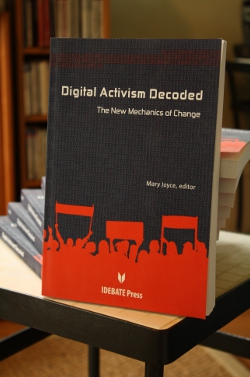
Digital Activism Decoded Cover

Recently the debate about the nature and effiacy of digital activism has become increasingly heated. Compare for example the dialogue between Patrick Meier and Evgeny Morozov. The first optimism of the early days has given way to a more balanced view on the motivation and effects of digital activism. In this ongoing debate a new book “Digital Activism Decoded: The New Mechanics of Change” edited by Mary Joyce offers a collection of texts that deal with digital activism from different perspectives. Mary offers her rationale for the book in this interview.

For this collection I cowrote a chapter with Dan Schultz with the title “Applications: Picking the Right One in a Transient World”. The chapter discusses practical questions, which activists have to face when choosing digital tools for their campaigns. The chapter is no scientific text, instead it tries to offer a practical guideline by which activists can make sense out of the many digital tools out there.

You can download the entire book for free at the Meta-Activism Project or order a paperbased version at amazon be it .de or .com.

[Update 2010/07/29]
Since its publication the book has received a fair amount of coverage:

The German publication Der Freitag has a review of the book.

The blog Sealing the Generation Gap reviews Dan’s and my chapter: “All human wisdom is contained in two words: wait and hope.” Must say, any review that mentions “The Count of Monte Christo” and a text of mine in the same article puts a smile on my face.

Also the authors of other chapters have been actively blogging on the publication of the book:

Steven J. Murdoch blogs on his chapter: “Destructive Activism: The Double-Edged Sword of Digital Tactics“.

Dave Karpf blogs on his chapter: “Measuring the Success of Digital Campaigns“.

Simon Columbus blogs on his chapter: “The New Casualties: Prisons and Persecution“.

In addition to that there is a video of a discussion with Mary Joyce at the New America Foundation.

Photo (c) Mary Joyce

KampagnenPraxis

In the coming months I will be joining the team of KampagnenPraxis. KampagnenPraxis is a nonpartisan working group of German online campaigning professionals. The aim of this group is to collect use cases of succesful online campaigns in Germany. My first reports will deal with the use of newsletters by the CDU during the campaign for the election in Nordrhein-Westfalen in early 2010 and the volunteer team NRW für Rüttgers during the same campaign.

[Update 2010/08/06]
Meanwhile my first report has been published:

Andreas Jungherr, Malte Krohn and David J. Ludwigs: Neues Kleid macht alten Newsletter erfolgreich.

Interview on the state of the CDU online campaign in NRW

A few days ago Malte Krohn [@malte_politicus] from the blog Homo Politicus interviewed me on the state of the CDU online campaign in Nordrhein-Westfalen which I advise on their use of online tools.

If you are interested in the campaign, I also wrote about it here, here and here.