What's new?

Read Blog

New article: Artificial intelligence and democracy

In a new article for Social Media + Society, I discuss the role of artificial intelligence (AI) for democracy.
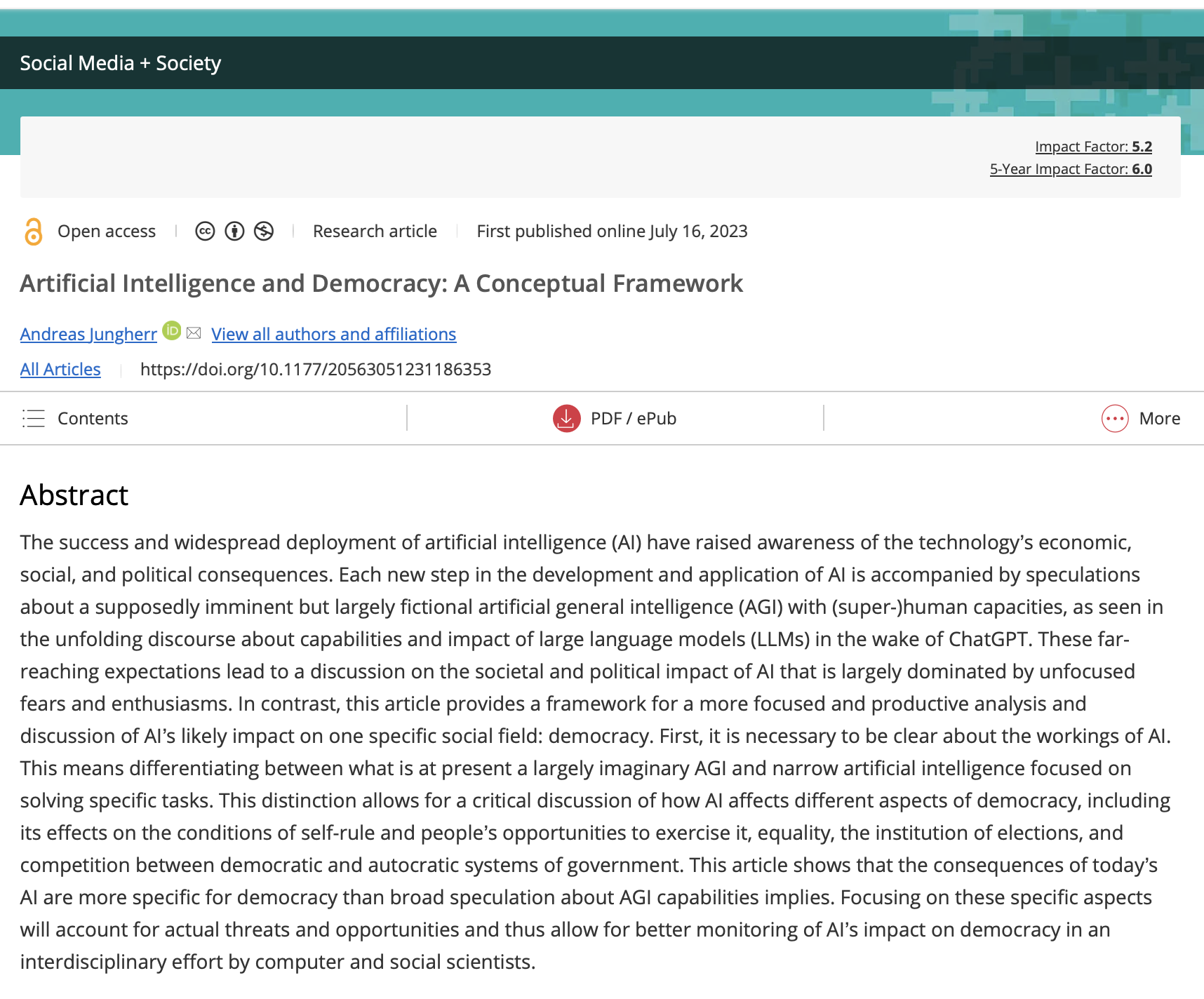
The article introduces a new conceptual framework for analyzing the functioning and impact of AI in democracy.

AI can change the conditions, practice, and conceptions of democracy on four levels:

  • For individuals, AI changes actual and perceived opportunities for political self-determination.
  • For groups, AI changes equality with the state and in political competition.
  • Institutionally, AI changes, actually or perceived, conditions and legitimacy of elections.
  • Systemically, AI can influence competition between democratic and autocratic systems.
  • Many of these developments lie in the future. And it remains open whether these AI-related influences strengthen or weaken democracy.

    But in order to contribute to the strengthening of democracy, it is important that the social sciences conceptualize the role of AI in democracy early in the process, observe its development and co-shape its use and governance.

    The article follows up on an article with Ralph Schroeder about the role of AI in the public arena.

    The article is part of the larger project “Communicative Power in Hybrid Media Systems”, which has received generous funding from the VolkswagenStiftung.

    Abstract: The success and widespread deployment of artificial intelligence (AI) have raised awareness of the technology’s economic, social, and political consequences. Each new step in the development and application of AI is accompanied by speculations about a supposedly imminent but largely fictional artificial general intelligence (AGI) with (super-)human capacities, as seen in the unfolding discourse about capabilities and impact of large language models (LLMs) in the wake of ChatGPT. These far-reaching expectations lead to a discussion on the societal and political impact of AI that is largely dominated by unfocused fears and enthusiasms. In contrast, this article provides a framework for a more focused and productive analysis and discussion of AI’s likely impact on one specific social field: democracy. First, it is necessary to be clear about the workings of AI. This means differentiating between what is at present a largely imaginary AGI and narrow artificial intelligence focused on solving specific tasks. This distinction allows for a critical discussion of how AI affects different aspects of democracy, including its effects on the conditions of self-rule and people’s opportunities to exercise it, equality, the institution of elections, and competition between democratic and autocratic systems of government. This article shows that the consequences of today’s AI are more specific for democracy than broad speculation about AGI capabilities implies. Focusing on these specific aspects will account for actual threats and opportunities and thus allow for better monitoring of AI’s impact on democracy in an interdisciplinary effort by computer and social scientists.

    Andreas Jungherr. 2023. Artificial Intelligence and Democracy: A Conceptual Framework. Social Media + Society 9(3): 1-14. doi: 10.1177/20563051231186353.
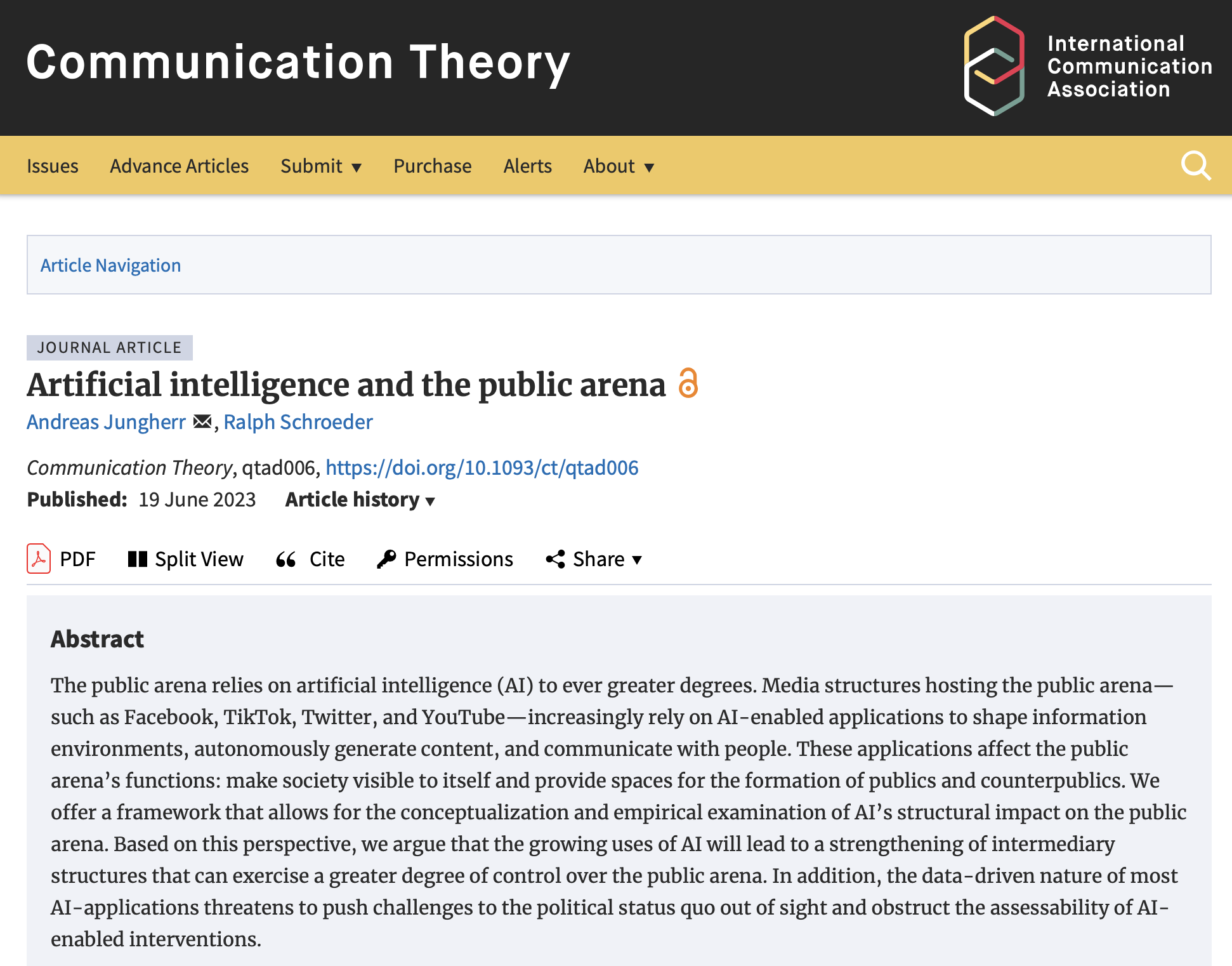
    New article: Artificial intelligence and the public arena

    In a new article for Communication Theory, Ralph Schroeder and I discuss the role of artificial intelligence (AI) in the public arena.

    In Artificial intelligence and the public arena, we present a novel theoretical framework for analyzing the uses, workings, and impacts of AI in the public arena.

    We prefer the term public arena over public sphere since its focus on structures allows a more focused discussion about the (shifting) conditions under which political discourse, competition, and self-reflection occur.

    We define the public arena as interconnected communicative spaces hosted by media structures – e.g. news media, digital platforms, & discursive institutions – that enable and constrain publication, distribution, reception, and contestation of information.

    AI features in the public arena mainly in three ways:

    – shaping information flows and user behavior,
    – generating content,
    – communicating agents.

    This has negatively impacted the assessability of the public arena, its structures, and workings. This threatens its legitimacy in mediating the relationship between people and political elites, hosting public discourse and political competition, and providing relevant information.

    We expect AI to increase control by

    – submerging new, challenging, or offending voices,
    – leading to greater demand for intermediary structures filtering unreliable or misleading AI-generated content,
    – demonetizing news media by offering access to the public arena mediated by communicating agents summarizing information found in digital communication environments.

    An AI-reliant public arena will largely shift away from a predominantly open, noisy, and sometimes offensive web toward structures allowing for greater control over safe and vetted spaces. This will further empower gatekeepers, weaken challengers, and reinforce the status quo.

    These are of course early days. Specific uses and implementations might shift. But whatever the outcome, social scientists must engage with AI’s role in the public arena by adapting or developing concepts and measurements that allow society to reflect and improve on those uses.

    The article is part of a special issue on “Reconceptualizing Public Sphere(s) in the Digital Age. On the Role and Future of Public Sphere Theory” by Mike S. Schäfer and Mark Eisenegger who did great work in putting together a set of inspiring articles. Very happy to be in that company.

    The article is part of the larger project Communicative Power in Hybrid Media Systems, which has received generous funding from the VolkswagenStiftung.

    Abstract: The public arena relies on artificial intelligence (AI) to ever greater degrees. Media structures hosting the public arena—such as Facebook, TikTok, Twitter, and YouTube—increasingly rely on AI-enabled applications to shape information environments, autonomously generate content, and communicate with people. These applications affect the public arena’s functions: make society visible to itself and provide spaces for the formation of publics and counterpublics. We offer a framework that allows for the conceptualization and empirical examination of AI’s structural impact on the public arena. Based on this perspective, we argue that the growing uses of AI will lead to a strengthening of intermediary structures that can exercise a greater degree of control over the public arena. In addition, the data-driven nature of most AI-applications threatens to push challenges to the political status quo out of sight and obstruct the assessability of AI-enabled interventions.

    Andreas Jungherr and Ralph Schroeder. 2023. Artificial intelligence and the public arena. Communication Theory (Online First). doi: 10.1093/ct/qtad006.

    New Working Paper: Using ChatGPT and Other Large Language Model (LLM) Applications for Academic Paper Assignments

    The current popularity of ChatGPT has challenged many societal fields. It is no surprise to find it also challenging university education. In this working paper, I am addressing some of the questions arising from widespread use of ChatGPT or other large language models (LLM) applications by students for the assignment of graded research paper assignments.

    Abstract: Large language models (LLMs), like ChatGPT, GitHub Copilot, and Microsoft Copilot, present challenges in university education, particularly for paper assignments. These AI-driven tools enable students to (semi)automatically complete tasks that were previously considered evidence of skill acquisition, potentially affecting grading and skill development. However, the use of these tools is not legally considered plagiarism and is becoming increasingly integrated into various software solutions.

    University education in the social sciences aims to develop students’ abilities to make sense of the world, connect their observations with abstract structures, measure phenomena of interest, systematically test expectations, and present findings in structured accounts. These practices are learned through repeated performance of tasks, such as writing research papers. LLM applications like ChatGPT create conflicting incentives for students, who might rely on them to produce parts of their papers instead of engaging in the learning process.

    While LLMs can be helpful tools for knowledge discovery, writing assistance, and coding assistance, using them effectively and safely requires an understanding of their underlying mechanisms, potential weaknesses, and enough domain knowledge to identify mistakes. This makes LLMs particularly challenging for students in the early stages of acquiring scientific skills and domain knowledge.

    Educators must enable and train students to responsibly use these new tools, reflecting on the underlying tensions and their strengths and weaknesses for academic writing tasks. This working paper aims to provide guidelines on responsible LLM use in academic contexts, specifically for students at the Chair for the Governance of Complex and Innovative Technological Systems at the University of Bamberg. The paper discusses the function of written paper assignments, the tasks necessary to complete them, and evaluates ChatGPT’s performance in assisting with these tasks. It concludes with observations and advice for students to maximize the benefits of LLMs while mitigating potential risks in academic contexts, focusing on enabling learning.

    Jungherr, A. (2023, March 24). Using ChatGPT and Other Large Language Model (LLM) Applications for Academic Paper Assignments. https://doi.org/10.31235/osf.io/d84q6

    Interview zur politischen Kommunikation und Social Media im Wahlkampf

    In Bayern steht der Landtagswahlkampf bevor. Mit dem uni.blog der Universität Bamberg habe ich über die Rolle von Social Media in der politischen Kommunikation gesprochen:

    Facebook, Instagram, TikTok, WhatsApp, YouTube – die Zahl der Social Media-Plattformen scheint schier endlos. Kein Wunder also, dass immer mehr Menschen Soziale Netzwerke nutzen und auch Unternehmen sie für ihre Marketing-Strategie gezielt einsetzen. Doch wie sieht es in der Politik aus? Kommunikationswissenschaftler Prof. Dr. Olaf Hoffjann, Politikwissenschaftler Prof. Dr. Andreas Jungherr und Politikstudent sowie Gründer des journalistischen Projekts “PolitikneugedachtLeón Eberhardt diskutieren darüber, welche Rolle die Sozialen Medien bei der Landtagswahl im Herbst 2023 spielen.

    Das vollständige Interview finden Sie hier.

    Welche Rolle spielt Desinformation in den US Midterms 2022?

    Welche Rolle spielt Desinformation bei den US-Midterms 2022? Darüber habe ich mit Judith Möller und Christian Hoffmann auf Einladung des Science Media Center Germany diskutiert.

    Ob wir richtig liegen zeigt die Zukunft!

    You are currently viewing a placeholder content from YouTube. To access the actual content, click the button below. Please note that doing so will share data with third-party providers.

    More Information

    New Publication: Review of Vaccari & Valeriani – Outside the Bubble (2021)

    In this brief book review, I discuss what I liked about Outside the Bubble: social media and political participation in western democracies, by Cristian Vaccari & Augusto Valeriani. Why not check it out, to see if you might like it too.

    Outside the Bubble is a very welcome addition to research on the effects of digital media on political participation. Its findings provide an important counterpoint to much of the simplistic popular narratives about detrimental effects of digital media on participation. Especially by providing broad comparative evidence across nine countries, Vaccari and Valeriani provide an important template for future work, taking potential variations across countries and political contexts seriously instead of merely paying lip-service to the need for comparison.

    Clearly, as the authors show, echo chambers and filter bubbles are the wrong metaphors to describe what most people experience in online communication environments. But this does not mean that those users who do, or those who enter largely homogenous environments at times do not experience specific effects, some beneficial some detrimental to political participation and democracy. Here, the work by Vaccari and Valeriani offers many promising points for moving forward.

    Andreas Jungherr. 2022. Review of Cristian Vaccari & Augusto Valeriani (2021). Outside the Bubble: social media and political participation in western democracies. Journal of Information Technology & Politics. (Online First). doi:10.1080/19331681.2022.2136321

    Lehrveranstaltungen Wintersemester 2022/3

    Im Wintersemester 2022/3 bietet der Lehrstuhl für Politikwissenschaft, insbesondere Steuerung innovativer und komplexer technischer Systeme wieder eine Reihe von Kursen in den Bereichen Technikgovernance und Computational Social Science an. Dieses Semester bin ich im Forschungssemester, bin also im Kursportfolio etwas weniger vertreten als sonst. Dafür bietet das Lehrstuhlteam allerdings einen spannenden Mix etablierter und neuer Kurse im Bachelor und Master an.

    Im Bachelor bietet Jon Meyer ein Seminar zum Thema Technik Governance an.

    Gesellschaften sind geprägt von vielfältigem technologischem Wandel. Dies stellt sie vor neue Aufgaben. Welche direkten und indirekten Wirkungen technologischen Wandels treten auf oder sind zu erwarten? Wie lassen sich diese frühzeitig erkennen und gegebenenfalls steuern? Wie reagiert die Bevölkerung auf technologischen Wandel? Wer entscheidet über die Rahmenbedingungen der Entwicklung, Bereitstellung und Nutzung von Technologien?

    Dieses Seminar gibt einen Überblick über die Herausforderungen gesellschaftlicher Steuerung technologischen Wandels, stellt steuernde Akteure und Strukturen vor und diskutiert direkte Interventionsmöglichkeiten am Beispiel der Akzeptanz- und Innovationsförderung. Dies wird an unterschiedlichen Technologiebereichen illustriert, wie zum Beispiel Künstliche Intelligenz, Klimawandel, Pandemien und BioTech.

    Außerdem konnten wir den Rechtsanwalt mit Schwerpunkt IT-Sicherheit und Datenschutz Dirk Koch für einen Lehrauftrag gewinnen. Er wir im Bachelor ein Blockseminar zum Thema Daten und Datensicherheit in der EU anbieten.

    Datentransfer und die damit verbunden Rechte und Pflichten für Unternehmen sowie Verwaltungen rücken immer mehr in den Fokus der Aufmerksamkeit. Zuletzt entfachte eine angeregte Diskussion über die transatlantische Übertragung von personenbezogenen Daten z.B. Schrems II.

    Der Kurs soll einen Einblick in die rechtlichen Anforderungen an den Transport und die Sicherung von Daten geben. Dabei sollen die Gefahren und Möglichkeiten des Internets für Daten analysiert werden sowie Spannungsfelder wie der Datenaustausch mit Drittstaaten, Datensicherheit vs. Persönliche Freiheit, Sicherheitsinteressen des Staates vs. Freiheitsrechte des Einzelnen und der Begriff des Dateneigentums erarbeitet werden. Nach der Erarbeitung der vorgenannten Themenfelder sollen diese im Kontext der staatlichen Steuerung / Regulierung auf nationaler und europäischer Ebene eingeordnet werden.

    Im Master wird Daniel Mayerhoffer die Vorlesung Digital Media in Politics and Society im Blockformat anbieten.

    The goal of this lecture is to help you to make sense of digital technology – the changes it brings, the opportunities it provides, and the challenges it presents. In order to do so, we look at some of the biggest controversies about the uses of digital media in politics and society. We look beyond the headlines and see what scientific evidence is available, how this evidence is produced, and what it does tell us about the role of digital media in politics and society. This podcast will introduce you to the best available evidence on ongoing controversies, enable you to ask better questions on the role of digital media in politics and society, and show you the tools that allow you to answer them.

    Here are the main topics, we will be talking about: Computational social science, artificial intelligence and it’s impact on politics, data & algorithms, the challenge to institutions, and the public arena.

    Auch im Master wird Sergei Pashakhin einen Kurs zum Thema Computational Text Analysis for Social Science anbieten. Der Titel dürfte selbsterklärend sein.

    Darüber hinaus biete ich dieses Semester wie immer ein Seminar zu Aktuellen Forschungsproblemen und -methoden im Bachelor und Master an, das interessierten Studierenden die Möglichkeit gibt, Forschungsfragen für Ihre Abschlussarbeiten zu entwickeln und vorzustellen.

    Alle Kurse haben aktuell noch freie Plätze. Melden Sie sich also gerne im Verlauf dieser und der nächsten Woche an, wenn Sie Interesse haben.