
What I Do
How do societies manage technological change?
I am interested in the digital transformation and how societies, institutions, organizations, and people adapt.
DIGITAL TRANSFORMATION
ARTIFICIAL INTELLIGENCE
PERSUASION
University of Bamberg
Prof. Dr. Andreas Jungherr
I am Professor for Political Science, especially Digital Transformation at the Institute for Political Science at the University of Bamberg.
My research focuses on how societies deal with artificial intelligence and digital technology.
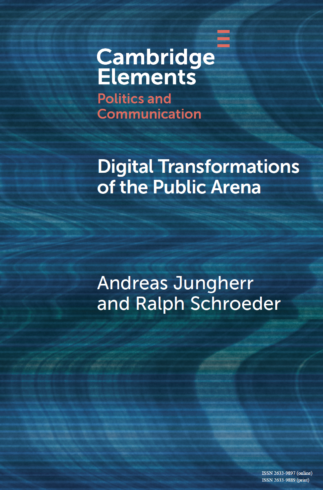
In the book Digital Transformations of the Public Arena (2022, Cambridge University Press), my co-author Ralph Schroeder and I discuss the impact of digital media on news, politics, and the public arena.
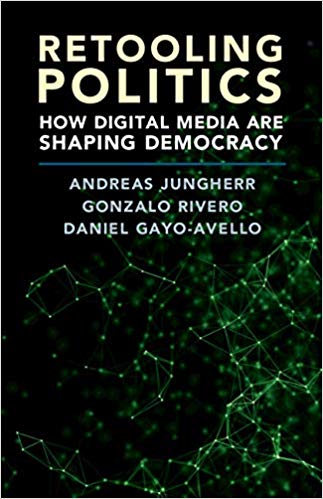
In the book Retooling Politics (2020, Cambridge University Press), my co-authors and I provide an easy to follow introduction to various ways that digital media influence politics.
In various articles, I examine the impact of artificial intelligence on democracy and the public arena. Other articles discuss and examine political communication, persuasion, contemporary media systems, disinformation, digital campaigning, attitudes toward trade and globalization, and computational social science.
Currently, I am writing a book for Cambridge University Press discussing different ways how the social sciences can inform computer science in the design, deployment, and governance of artificial intelligence.
I am also working on a project funded by the VolkswagenStiftung identifying and measuring the power dynamics between legacy, new, and social media in the coverage of important societal events and topics.


Disinformation
Negative Downstream Effects of Alarmist Disinformation Discourse: Evidence from the United States
The threat of disinformation features strongly in public discourse, but scientific findings remain conflicted about disinformation effects and reach. Accordingly, indiscriminate warnings about disinformation risk overestimating its effects and associated dangers. Balanced accounts that document the presence of digital disinformation while accounting for empirically established limits offer a promising alternative. In a preregistered experiment, U.S. respondents were exposed to two treatments designed to resemble typical journalistic contributions discussing disinformation. The treatment emphasizing the dangers of disinformation indiscriminately (T1) raised the perceived dangers of disinformation among recipients. The balanced treatment (T2) lowered the perceived threat level. T1, but not T2, had negative downstream effects, increasing respondent support for heavily restrictive regulation of speech in digital communication environments. Overall, we see a positive correlation among all respondents between the perceived threat of disinformation to societies and dissatisfaction with the current state of democracy.
News



Artificial Intelligence (AI)
Artificial intelligence and democracy: A conceptual framework
The success and widespread deployment of artificial intelligence (AI) have raised awareness of the technology’s economic, social, and political consequences. Each new step in the development and application of AI is accompanied by speculations about a supposedly imminent but largely fictional artificial general intelligence (AGI) with (super-)human capacities, as seen in the unfolding discourse about capabilities and impact of large language models (LLMs) in the wake of ChatGPT. These far-reaching expectations lead to a discussion on the societal and political impact of AI that is largely dominated by unfocused fears and enthusiasms. In contrast, this article provides a framework for a more focused and productive analysis and discussion of AI’s likely impact on one specific social field: democracy. First, it is necessary to be clear about the workings of AI. This means differentiating between what is at present a largely imaginary artificial general intelligence (AGI) and narrow artificial intelligence focused on solving specific tasks. This distinction allows for a critical discussion of how AI affects different aspects of democracy, including its effects on the conditions of self-rule and people’s opportunities to exercise it, equality, the institution of elections, and competition between democratic and autocratic systems of government. This article shows that the consequences of today’s AI are more specific for democracy than broad speculation about AGI capabilities implies. Focusing on these specific aspects will account for actual threats and opportunities, and thus allow for better monitoring of AI’s impact on democracy in an interdisciplinary effort by computer and social scientists.

Artificial intelligence and the public arena
The public arena relies on artificial intelligence (AI) to ever greater degrees. Media structures hosting the public arena—such as Facebook, TikTok, Twitter, and YouTube—increasingly rely on AI-enabled applications to shape information environments, autonomously generate content, and communicate with people. These applications affect the public arena’s functions: make society visible to itself and provide spaces for the formation of publics and counterpublics. We offer a framework that allows for the conceptualization and empirical examination of AI’s structural impact on the public arena. Based on this perspective, we argue that the growing uses of AI will lead to a strengthening of intermediary structures that can exercise a greater degree of control over the public arena. In addition, the data-driven nature of most AI-applications threatens to push challenges to the political status quo out of sight and obstruct the assessability of AI-enabled interventions.

Using ChatGPT and Other Large Language Model (LLM) Applications for Academic Paper Assignments
Applications based on large language models (LLMs), like ChatGPT, GitHub Copilot, and Microsoft Copilot, present challenges in university education, particularly for paper assignments. These AI-driven tools enable students to (semi)automatically complete tasks that were previously considered evidence of skill acquisition, potentially affecting grading and skill development. Educators must enable and train students to responsibly use these new tools, reflecting on the underlying tensions and their strengths and weaknesses for academic writing tasks. This working paper aims to provide guidelines on responsible LLM use in academic contexts. The paper discusses the function of written paper assignments, the tasks necessary to complete them, and evaluates ChatGPT’s performance in assisting with these tasks. It concludes with observations and advice for students to maximize the benefits of LLMs while mitigating potential risks in academic contexts, focusing on enabling learning.

Podcast Lecture Series
Digital Media in Politics and Society
One of the most important challenges societies face today is how to make sense of digital media. We are deeply uncertain about their impact: mechanisms, conditions, and opportunities of and for their uses remain unclear. The goal the podcast is to help you to make sense of digital media, the changes it brings, and the challenges it presents. This podcast accompanies the lecture series Digital Media in Politics & Society of the Chair for Political Science, Digital Transformation at the University of Bamberg.
Current Episode
Click on the button to load the content from embed.podcasts.apple.com.

Book
Digital Transformations of the Public Arena
Digital technologies have changed the public arena, but there is little scholarly consensus about how they have done so. This Element lays out a new framework for the digitally mediated public arena by identifying structural changes and continuities with the pre-digital era. It examines three country cases – the United States, Germany, and China. In these countries and elsewhere, the emergence of new infrastructures such as search engines and social media platforms increasingly mediate and govern the visibility and reach of information, and thus reconfigure the transmission belt between citizens and political elites. This shift requires a rethinking of the workings and dysfunctions of the contemporary public arena and ways to improve it.
Book
Retooling Politics: How Digital Media are Shaping Democracy
Donald Trump, the Arab Spring, Brexit: digital media have provided political actors and citizens with new tools to engage in politics. These tools are now routinely used by activists, candidates, non-governmental organizations, and parties to inform, mobilize, and persuade people. But what are the effects of this retooling of politics? Do digital media empower the powerless or are they breaking democracy? Have these new tools and practices fundamentally changed politics or is their impact just a matter of degree? This clear-eyed guide steps back from hyperbolic hopes and fears to offer a balanced account of what aspects of politics are being shaped by digital media and what remains unchanged. The authors discuss data-driven politics, the flow and reach of political information, the effects of communication interventions through digital tools, their use by citizens in coordinating political action, and what their impact is on political organizations and on democracy at large.
Interviews
What others are saying

Retooling Politics is simply the best book I have read on politics in the digital age. The authors show how political actors use legacy media, digital platforms, and data driven strategies to change how public information is produced, distributed, received, evaluated and used. This book updates the entire field with a timely focus on contemporary problems of democracy. It is destined to become a classic.
University of Washington
In this provocative, fresh account of the power of digital media in politics, the authors bundle insights from various fields to provide an accessible account of the many ways digital media are shaping contemporary politics. This timely and welcome book will be highly useful for anyone seeking to understand this complex and evolving issue.
London School of Economics and Political Science
This book gives a nuanced analysis of digital media in politics, focusing on political actors’ needs, flows and costs of information, and connections to publics. The authors offer readers a careful and systematic approach to the big question of whether digital media strengthen or undermine democracy.
University of California, Santa Barbara
The effects of digital media on politics and democracy are far-reaching, diverse, quickly evolving, and difficult to grasp. Retooling Politics is an essential resource for anyone trying to make sense of the connection between digital media and politics – and to understand what we actually know about it.
University of Zurich
Jungherr, Rivero and Gayo-Avello’s Retooling Politics is simply exquisite. By all means this book represents one of the finest accounts I have come across to explain why and how digital media is the largest and most profound transformative power in today’s democracy. With a comprehensive, meticulous, and sharp use of the most current and influential literature in the social sciences, the authors build a brilliant and multi-disciplinary argument that will guide readers to better grasp how digital media has transformed our political realm.
University of Vienna
Retooling Politics offers a fresh and nuanced ‘needs-based’ framework for analyzing the effects of digital media on political life. This is a necessary book that cuts through hyperbole in its grounded, procedural analysis of what has actually changed in politics, from how organizations pursue their ends to the voices that count in public life.
UNC Center for Information, Technology, and Public Life
All over the world, old political goals are pursued with new political tools. Retooling Politics’ needs-based approach presents a nuanced new way of thinking about the impact not on specific political outcomes, or on the basic goals of political actors, but on the practical and institutional process of politics. Thus, this book will help combat the catchy but simplistic narratives advanced by digital cheerleaders and doom-mongers and contribute to more realistic and evidence-based alternatives.
University of Oxford
This book offers a fresh and comprehensive perspective on the needs that digital media fulfill in the context of democratic politics. The wide-ranging analysis explores the needs that digital media provides for political organizations, for the spread of information, and for enabling collective action in the broadest sense.
Syracuse University
Reviews


Article
A Source Like Any Other? Field and Survey Experiment Evidence on How Interest Groups Shape Public Opinion
Interest groups increasingly communicate with the public, yet we know little about how effective they are in shaping opinions. Since interest groups differ from other public communicators, we propose a theory of interest group persuasion. Interest groups typically have a low public profile, and so most people are unlikely to have strong attitudes regarding them. Source-related predispositions, such as credibility assessments, are therefore less relevant in moderating effects of persuasive appeals by interest groups than those of high-profile communicators. We test this argument in multiple large-scale studies. A parallel survey and field experiment (N = 4,659) establishes the persuasive potential of low-profile interest groups in both controlled and realistic settings. An observational study (N = 700) shows that substantial portions of the public are unable to assess interest group credibility. A survey experiment (N = 8,245) demonstrates that credibility assessments moderate the impact of party but not interest group communication.
Cowritten with Alexander Wuttke, Matthias Mader, and Harald Schoen.

Article
Discursive Power in Contemporary Media Systems: A Comparative Framework
Contemporary media systems are in transition. The constellation of organizations, groups, and individuals contributing information to national and international news flows has changed as a result of the digital transformation. The “hybrid media system” has proven to be one of the most instructive concepts addressing this change. Its focus on the mutually dependent interconnections between various types of media organizations, actors, and publics has inspired prolific research. Yet the concept can tempt researchers to sidestep systematic analyses of information flows and actors’ differing degrees of influence by treating media systems as a black box. To enable large-scale, empirical comparative studies aimed at identifying interdependencies and power relationships in contemporary media systems, we propose the concept of discursive power. This describes the ability of contributors to communication spaces to introduce, amplify, and maintain topics, frames, and speakers, thus shaping public discourses and controversies that unfold in interconnected communication spaces. We also provide a theoretical framework of how structural features of organizations and media systems contribute to the emergence of discursive power for different types of actors in various contexts. This adds to the theoretical toolkit available to researchers interested in the empirical analysis of contemporary media systems.
Cowritten with Oliver Posegga and Jisun An.

Book
Analyzing Political Communication with Digital Trace Data: The Role of Twitter Messages in Social Science Research
This book offers a framework for the analysis of political communication in election campaigns based on digital trace data that documents political behavior, interests and opinions. The author investigates the data-generating processes leading users to interact with digital services in politically relevant contexts. These interactions produce digital traces, which in turn can be analyzed to draw inferences on political events or the phenomena that give rise to them. Various factors mediate the image of political reality emerging from digital trace data, such as the users of digital services’ political interests, attitudes, or attention to politics. In order to arrive at valid inferences about the political reality on the basis of digital trace data, these mediating factors have to be accounted for. The author presents this interpretative framework in a detailed analysis of Twitter messages referring to politics in the context of the 2009 federal elections in Germany. This book will appeal to scholars interested in the field of political communication, as well as practitioners active in the political arena.

Project: VolkswagenStiftung
Discursive Power in Contemporary Media Systems
Contemporary media systems are shaped by diverse constellation of organizations, groups, and individuals contributing information to national and international news flows. In our project, we analyze interdependencies and power relationships among these new constellations. We do so through the concept of discursive power: the ability of contributors to communication spaces to introduce, amplify, and maintain topics, frames, and speakers in interconnected communication spaces.
The project has received generous funding by the VolkswagenStiftung in the funding line “International Research in Computational Social Sciences”.
We are an interdisciplinary team of early-career researchers coming from computer, information and the social sciences. Our interdisciplinary backgrounds allow us to realize the research potential of computational social science informed by both computer and social science without being limited by either.

Jisun An
School of Information Systems, Singapore Management University (SMU-SIS)

Andreas Jungherr
Institute for Political Science at the University of Bamberg

Oliver Posegga
Department of Information Systems and Social Networks at the University of Bamberg
Project
Media change and politics in the information age: Interconnections and cultural reflections
Media and political systems are deeply interconnected. Specific constellations of media technology, economic foundations, and audience behavior shape the public arena, the opportunities for people to form and express political opinions, and the conditions of political competition. Accordingly, media change and political change are interconnected. But the media do not only shape politics, they also reflect changes and associated anxieties back through cultural products. This project examines these interconnections between media and political change through the analysis of select episodes of media and political change in the US.
The project is an interdisciplinary collaboration between the Americanist Damien Schlarb (University of Mainz) and the political and communication science Andreas Jungherr (University of Bamberg). It proceeds from an interdisciplinary analytical framework by joining social-scientific, philological, and media-historical methodologies. The investigation of the correlations and cross-pollinations of media and political change provides answers to larger structural questions about the nature of social and cultural change in the information age.

Damien Schlarb
Obama Institute for Transnational American Studies at the University of Mainz
Andreas Jungherr
Institute for Political Science at the University of Bamberg