What's new?

Read Blog

Tribes in a Sea of Change

To Seth Godin we are living in a new world. A world where success does not depend on doing things the way they were done in the past. A world where playing it safe actually means betting the house. A world where the best way to success is to break with everything that seemed true yesterday and to do exactly the opposite today. In this world only through embracing the chance of failure one can achieve success.

This is the background for the new book by Seth GodinTribes: We Need You to Lead Us“. In this book Godin declares the tribe to the next successful form of social organization and demands of his reader to rise to the challenge and form a tribe around an idea.

To Godin tribes are:

“a group of people connected to one another, connected to a leader, and connected to an idea.” (Tribes 2008: 1).

This is a fairly wide definition, but Godin differentiates further between tribes that embrace change and those that oppose it.

To him tribes that formed in the past around an idea run the danger of perpetuating an institution in the hope of keeping an old idea alive in spite of changing times. In his eyes these tribes are doomed.

Instead, to Godin, a tribe has to become a micromovement to be successful.

Godin identifies six principles for a micromovement:

1. Transparency
2. The Movement has to be bigger than its leader
3. Movements that grow thrive
4. Movements are most successful if they clearly differentiate themselves from the status quo
5. Excluding Outsiders
6. Enabling Followers to be more successful

Only through this openness to change and the active participation of its members a tribe can be successful, so Godin.

To become and remain a micromovement tribes need leaders. In Godins eyes these leaders are we, the readers. To Godin leaders differentiate themselves through the conscious decision to lead a tribe, instead only to participate in a movement. They are motivated by curiosity and a desire for change. Their ability to lead, their charisma, is derived from their uncompromising faith in the core of their movement. The narrative of this faith gives the followers something to believe in and something to work for. With his short manifesto Godin tries to infuse the reader with the passion and confidence to make that decision and to step up and lead his own tribe.

For Godin, today is the time for heretics in leadership positions. A chaotic present and a future where seemingly anything goes, lead the market to embrace change. In the past curiosity and the desire to change the status quo seemed frightening because this attitude lead to the possibility of failure and with this it threatened success. Today it’s different. Godin argues, that since success is more and more based on change of the status quo and unpredictable factors, the market demands heretics as leaders. Heretics whose radical challenge to the status quo were in the past anathema to investors are in Godins eyes necessary.

In this short book Godin thinks out loud about leadership in a time of change and the ties that bind subgroups in a society which differentiates itself ever increasingly along the long tails of interest, practice, place and ideas. This book is not so much an analysis of leadership, small group behavior or organization in times of the social web (try for this “Herd” by Mark Earls and “Here Comes Everybody” by Clay Shirky), it is clearly a book of ideas. Herein it reminds of the short books by Tom Peters on leadership and talent. Godin tries to inspire the reader and move him to action.

A great shortcut to the ideas of “Tribes” is this interview between Seth Godin and the blogger and cartoonist Hugh MacLeod.

Should Politicians Blog? Part 1

In 2004 the French blogger and serial entrepreneur Loïc Le Meur [loiclemeur] posted on his blog 10 Reasons why Should a Politician Blog. For him blogs are a great way for politicians to start closer and deeper conversations with their constituencies. Le Meur’s reasons are convincing and blogs have proven their value as communication tools (see for example: How Companies Blog. Yet German politicians seem hesitant to use blogs.

The German journalist Christian Stöcker writes on German politicians and the net:

Das politische Netz hierzulande ist in einem erbärmlichen Zustand, die paar politisch orientierten Weblogs, die es gibt, haben kaum Leser, eine Debattenkultur existiert so gut wie nicht. Deutschlands Blogger sind immer noch zu einem großen Teil damit beschäftigt, entweder über den eigenen Alltag oder über das Bloggen selbst zu bloggen. Und die deutsche Politik betrachtet das Netz vor allem als etwas, das es zukontrollieren, reglementieren und überwachen gilt – und ist ansonsten weitgehend frei von Kenntnissen über das Medium der Zukunft.

This is not only a German phenomenon. In the article Political Blogs: Why the Internet Frightens Politicians the author states:

The internet frightens politicians. They can’t control it, so they see it as a threat; websites and blogs are time-consuming and dangerous, containing words that could later be held against them. What other explanation can there be for the fact that only 30 out of 650 MPs in Parliament have blogs?

The advocates for the status-quo are quick to find reasons why blogs do not matter as a tool in the political communication kit:

Blogs would be no part of the serious political discourse of the established media and even poison the political discussion through extreme partisanship (see as an example for this reasoning: A Parody of Democracy by Oliver Kamm).

The conversations on a blog would lead to a loss of control for the politician (see as an example for this reasoning the analyses: Blogs im Dienst politischer Kommunikation).

A blog would simply be a waste of time since the number of readers would be too small to play a significant role on election night (A recent Harris Poll seems to support this argument, stating that only 22 percent of US citizens regularly read political blogs. Although, this percentage is probably high in comparison to other contries). This critique seems to me quite shortsighted. In the coming days, I will explore the possibilities of web-based political communication and discourse by further examining the usefulness of blogging for politicians.

The first post in this series will deal with the nature of conversations on blogs. I will take a closer look on how professionals in different career paths use blogs to connect with communities in their fields. Accordingly, I focus on professional and career blogs, i.e. blogs that are maintained by professionals in different fields for means of professional development. In turn, I will disregard news aggregation blogs, gossip blogs or mere diary blogs. Professional blogs most closely resemble the genre, tone, and conditions under which politicians would blog.

It is save to assume that blogs are here to stay. What started out as a way to log one’s private thoughts in a public confessional has grown into a tool for social change. Professionals in different fields use blogs to connect with their audience. Novelists accompany their books with blogs (see for example the blog by the English novelist Neil Gaiman). Journalists embrace blogs and use them as an open notebooks during their work on more traditional articles (see for example the blog by The Atlantic corespondent James Fallows or even as a substitute for work in more traditional media outlets (see for example Mike Smithson’s blog Political Betting). Corporations try to connect to their customer base through personal blogs by employees (see for different corporate uses of blogs this post by Steve Rubel [steverubel]). Political Activists use blogs as a tool to surpass censorship and to break the information monopoly of their respective governments (see for example Global Voices an aggregate site for blogs by political activists).

Why do these professionals with jobs and already busy schedules decide to blog? The Überblogger Robert Scoble [scobleizer] writes on his reasons for blogging:

I blog for a few reasons: 1) I’m a geek and love telling people about cool things I’ve found. 2) If I put them on my blog, I know that Google will be able to help me find them later on. 3) It lets me have a conversation with a wide variety of people every evening. 4) After reading me, readers of my blog often teach me more than I knew on a specific topic. 5) I’ve been given a certain amount of “Google Juice”? and I enjoy pointing at people and sharing my GooglePower. Even folks I don’t always agree with (you do notice that by linking to Microsoft’s competitors I’m helping out their ranking in Google, don’t you?) 6) I like telling stories about people and situations I’ve been in thanks to my view of the high-tech industry. 7) I am impelled to write it. Translation: I’m addicted. I want to write down some of my history and keep track of interesting things I’ve done so that I can go back and enjoy them later on (and so my son, wife, and family can stay involved in my life too). 9) I enjoy learning about conversational marketing. I really do believe that blogging will someday be a “new PR arm”? of most major corporations. By blogging every day, I can learn a set of “best practices”? that I can teach to others at Microsoft and at other corporations. 10) I’m a news hound and enjoy reporting things before other people (or now, services like Technorati or Daypop) can get to them.

Thus, Scoble’s motives are delivering a service to the community of interest that formed around his blog and the sheer joy of communicating with his readers. His blog is not just about getting his message out or selling stuff to customers.

Another reason for blogging is learning. The Social Media Analyst Jeremiah Owyang [jowyang] states the paramount reason for his blogging:

It helps me learn: every topic I post on, someone will add additional thoughts in the comments, so more is gleaned than just me mouthing off. In fact, I get over 7 comments per post on average, so that’s at least a few more perspectives that just mine.

Some non-fiction authors even accompany their writing process with regular blog postings and extensive discussions with their readers; these discussions often influence their work in progress.

A good example for this scenario is the blog The Long Tail by Wired editor-in-chief Chris Anderson that he established as a collection of open research notes during his work on his book The Long Tail, a process that he decided to continue in his work on his new project Free. In a blogpost in 2006, Anderson stated how the blog and the discussions it started helped his work on the book:

Part of the reason the book is successful, I believe, is because as I was writing it the smart readers of this blog helped improve the ideas, catch my errors and suggest dozens of applications and dimensions of the Long Tail I never would have thought of myself. So today’s recognition is also a recognition of the power of tapping collective intelligence. I couldn’t have done it without you!

Earlier in 2008, the blogger Hugh MacLeod [gapingvoid] started to develop his ideas on Social Objects on his blog and in his Twitter-Feed. His three posts on the topic Social Objects for Beginners 2007/12/31, Why the Social Object is the Future of Marketing 2008/01/02 and The Social Marker – The Social Object on Steroids 2008/01/16 with their respective comment-sections are perfect examples for the process of group learning. Here we witness how the author and the readership of his blog develop a new idea through intensive dialogue conducted in an online envorinment.

These examples show that the power of blogs lie in the power of the conversations they start. These conversations allow the rapid prototyping of ideas and concepts. An idea can be stated by an author, tested by a community of interest and if necessary further developed. All this in a manner of days if not hours.

As our survey shows, several scholars, political analysts, and writers of fiction have acknowledged and embraced the benefits of blogging and incorporated them into their works. Meanwhile, the Net itself has long become an outlet for more philosophically motivated posts. In 1999, Christopher Locke, Rick Levine, Doc Searls [searls] and David Weinberger [dweinberger] wrote in their still radical Cluetrain Manifesto about this process:

While the outcome of these debates did not invariably constitute wisdom for the ages, the process by which they took place was honing a razor-sharp sense of collective potential. The conversation was not only engaging, interesting, exciting – it was effective. Tools and techniques emerged with a speed that broke all precedents. As would soon become obvious, the Net was a powerful multiplier for intellectual capital. (The Cluetrain Manifesto. 2000. p. 5).

While this statement was relevant for websites and online-forum discussions, it is even more relevant for blogs. Blogs made it even easier to publish on the web than HTML. For instance, micro-blogging tools like Twitter increase the speed of online conversations even further.

Still, there is a flip side to these positive notions. Not all commentators see a force for intellectual progress in online conversations. For example, Adam Curtis, a director of political documentaries, calls bloggers bullies:

Quite frankly, it’s quite clear that what bloggers are is bullies — they’re deeply emotional, they’re bullies, and they often don’t get out enough. And they are parasitic upon already existing sources of information — instead of leading to a new plurality or a new richness, [online conversation] leads to a growing simplicity. The bloggers from one side act to try to force mainstream media one way, the others try to force it the other way. So what the mainstream media ends up doing is it nervously tries to steer a course between these polarized extremes.

This negative view on the blogosphere was recently reinforced through a case of conference twittering. An audience, connected through the micro-blogging service Twitter, turned hostile during a podium discussion that was moderated by the journalist, Sarah Lacy [sarahcuda] (for two accounts of the event see: The “Nuclear Disaster”? At SXSW Was Nothing More Than A Witch Burning and Audience of Twittering Assholes).

Should politicians choose to become part of this often volatile online conversation? How can they use the benefits of a closely connected community and yet stay clear of hostile and partisan online behavior? In the coming days, I will explore these questions in greater detail. Meanwhile feel free to chime in.

I want to thank Damien Schlarb, who proofread this post and so ensured that it roughly resembles English.


The Shelves of my Quantum Library

A few days ago @zenpundit wrote on his blog about the concept of the quantum library. Jay@Soob has tracked this idea back to a posting on The Innovationist blog. Here a quantum library is defined as containing

the layer that co-exists as a member of both the Library and the Anti-Library. It is something you may have read, but when read again with a different perspective it exists in another form. These type’s of books are the ultimate for a bibliophile. It is the layer described above and contains the texts that you re-read.

Since a former project by @zenpundit and Soob regarding the antilibrary proved to be great fun, I started to think about my quantum library. So, after careful consideration, here are the books that qualify for the shelves of my quantum library:

Niccolò Machiavelli: Il Principe For a political scientist with a focus on the dos and don’ts of practical political leadership, this is an embarrassingly obvious choice. Machiavelli’s short text proves different each time around. It was a different book after I visited Firenze, I read it differently after I worked on a political campaign and when I reread it in preparation for my thesis I found yet another text. Now I am waiting for its next incarnation.

Michel de Montaigne: Essays Montaigne is the grand seigneur of all the men of letters. Locking himself away from the world and writing his multi-volume essays was in itself stuff of legends. The scope of his work guarantees different discoveries each time one opens the meanwhile well worn pages.

Jorge Luis Borges: Ficciones and El Aleph Borges’ short stories are always rewarding but I find myself regularly revisiting his stories “The Immortal” and “The Babylon Lottery“. Always rich and always different.

Golo Mann: Wallenstein This incredibly detailed narrative of Wallensteins life and time tells of a man of action who in a time of manic change chose the vita activa. Like all great biographies this account of an active life changes its meaning to the reader with personal experience of battles won and battles lost.

Umberto Eco: Il pendolo di Foucault The first time I read Eco’s Pendulum I read it as a thriller of ideas. Only the second time I found it to be one of the greatest parables on the profession of historians. The permanent rewriting of history from the perspective of an ever advancing present has in all its grotesque splendor been seldom portrayed so accurately and so entertaining.

What would one find on the shelves of your quantum library?

The Shelves of my Antilibrary

In June, on a previous incarnation of this blog, I wrote about my antilibrary. Since meanwhile the concept of the quantum library makes the rounds I decided to reblog my antilibrary post as a preparation for the libraries to come. If you already read this please bear with me and wait for the shelves to come.

In his great book “The Black Swan“? Nassim Nicholas Taleb introduces the concept of an antilibrary:

The writer Umberto Eco belongs to that small class of scholars who are encyclopedic, insightful, and nondull. He is the owner of a large personal library (containing thirty thousand books), and separates visitors into two categories: those who react with “Wow! Signore professore dottore Eco, what a library you have! How many of these books have you read?” and others – a very small minority- who get the point that a private library is not an ego boosting appendage but a research tool. Read books are far less valuable than unread ones. The library should contain as much of what you do not know as your financial means, mortgage rates, and the currently tight real estate market allow you to put there. You will accumulate more knowledge and more books as you grow older, and the growing number of unread books on the shelves will look at you menacingly. Indeed, the more you know, the larger the rows of unread books. Let us call the collection of unread books an antilibrary.
Nassim Nicholas Taleb: “The Black Swan”? 2007: p. 1.

The blogosphere has picked up on the antilibrary starting with the viral post “What is in your Antilibrary?“? by Münzenberg. I found this post via the blog zenpundit by @zenpundit. This made me look at my own shelves. So what books are in my antilibrary?

Through the work on my thesis I started to get more interested in the scientific process of the social sciences. Especially the divide between the formalistic and the hermeneutic approach to the enquiry into social phenomena seems fascinating to me. Therefor the books in my antilibrary show that interest:

Jon Elster: Explaining Social Behavior: More Nuts and Bolts for the Social Sciences. A great introduction into the basic concepts of social sciences. What are social sciences? What are valid questions that social scientists are able to answer? What is in the methodological toolkit of a social scientist?

Daniel Kahneman, Paul Slovic and Amos Tversky: Judgment under uncertainty: Heuristics and biases. And: Thomas Gilovich, Dale Griffin and Daniel Kahneman: Heuristics and Biases: The Psychology of Intuitive Judgment. Two great collections of articles dealing with human decisionmaking. A constant reminder how great social science looks like.

Hans-Georg Gadamer: Wahrheit und Methode: Grundzüge einer philosophischen Hermeneutik. One of the foundations for the 20th century school of hermeneutics. What are the boundaries of analytical methods for the analysis of social phenomena? What can we gain in understanding through the hermeneutic circle?

Michael Mann: The Sources of Social Power. One of the most ambitious academic projects of modern sociology. What are the constants in the organization of human societies? How is power distributed in societies?

Which books are on the shelves of your antilibrary?

5 Movies with Paul Newman

The Long, Hot Summer (1958) because of the lady who has to buy herself a bus ticket, because of the man with whom nobody wants to talk peacable, and because of the man who wonders what happens when he is dead.

The Hustler (1961) because of the man who does not now how he can lose, because you play pool fast and loose but also because character beats talent.

The Life and Times of Judge Roy Bean (1972) because people dress up when they go to see Miss Lilly, because of a drunken bear and the justice who is the handmaiden of the law. Now get a rope!

Slap Shot (1977) because for two minutes in the box you feel shame and then you get free, because you can’t put a bounty on a man’s head, and because well, we are human beings.

The Verdict (1982) because there is no other case!

5 Movies by David Mamet

The Spanish Prisoner (1997) because of the girl who lives above a bakery, the sunshine bakery.

The Winslow Boy (1999) because of the man who knows so little about women, the woman who knows so little about men and because one reads Lord Byron.

State and Main (2000) because everybody makes their own fun, else it be entertainment.

Heist (2001) because the place to be is in the sun.

Redbelt (2008) because there’s always an escape.

5 Filme von François Truffaut

Truffaut in Zurich

Baisers volés (1968) für Claude Jade, Delphine Seyrig und eine umgestossene Tasse Kaffee.

La sirène du Mississipi (1969) für La Reunion, eine zerbrochene Schallplatte und Schönheit die schmerzt.

Les deux anglaises et le continent (1971) für Kika Markham, gesprochene Briefe und Balzac.

La nuit américaine (1973) für die Musik von Georges Delerue, künstlichen Schnee und einen Zug in der Nacht.

La chambre verte (1978) für Truffaut, Nathalie Baye und einen Brief im Winter.

Image cc Andreas Jungherr.

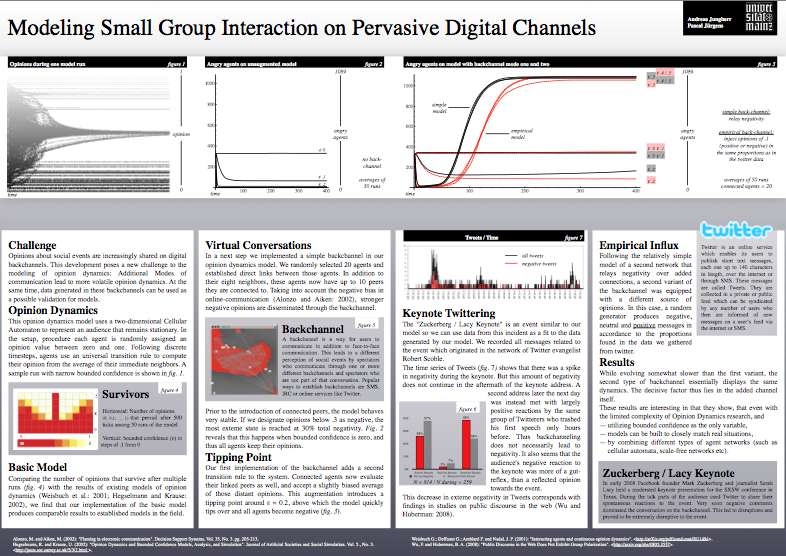
Modeling Small-Group Interaction on Pervasive Digital Channels: New Influence on Public Opinion

Andreas Jungherr and Pascal Jürgens (2008) “Modeling Small-Group Interaction on Pervasive Digital Channels: New Influence on Public Opinion”. Poster presented at the International Workshop on Challenges and Visions in the Social Sciences. Chair of Sociology, in particular of Modeling and Simulation, ETH Zurich, Switzerland on 18-23 August.

Modeling Small Group Interaction on Pervasive Digital Channels

Modeling Small Group Interaction on Pervasive Digital Channels

In the summer of 2008 Pascal Jürgens and I presented a poster at the International Workshop on Challenges and Visions in the Social Sciences organized by Dirk Helbing, Lars-Erik Cederman, Andreas Diekmann, Frank Schweitzer and Didier Sornette. In the poster we used agent based modeling to gain some understanding into the dynamics of communication on Twitter.

In the spring of 2009 we revisited this topic in a paper which Pascal Jürgens presented at the 11th General Online Research Conference, GOR 09 in Vienna, Austria.

For a higher resolution of the poster have a look at this pdf:

Andreas Jungherr and Pascal Jürgens (2008) “Modeling Small-Group Interaction on Pervasive Digital Channels: New Influence on Public Opinion”.