








In this essay the economist Tyler Cowen advances an enlightening conjecture on the reasons for the ongoing troubles of the US economy. He argues that there are two sources for widespread economic growth. To him one source is the development of new technologies and the attempt to solve hard social and scientific problems. As a second source he identifies economic growth based on the widespread adoption of new technologies and solutions of formerly hard problems. For Cowen the US, and probably in extensio the West, has spent the last century caching in the dividends of technological and social revolutions of the late 19th century. He calls this process “eating the low-hanging fruit”. Nothing wrong with that except that this source of economic growth over time yields increasingly low results and the ongoing allocation of ressources to these low-hanging fruits keeps a society from working on the hard problems. To Cowen this is the reason for the current economic stagnation in the US. The solution:
Raise the social status of scientists.
Which sounds about right to me, since who wants to live in a world run by glorified accountants and process optimizers?
To me, the most interesting argument was the chapter in which Cowen focuses on innovations brought on by the internet. He argues that the internet, while bringing its innovations to an ever increasing number of users, has not created significant revenue for society as a whole since most of its services are brought to the users for free. Also he points out that the most successful internet companies employ comparably few people. For Cowen this is one of the reasons for the “jobless recovery”.
This book advances a very interesting argument and offers an original perspective on how to think about innovation and economic growth. For an in-depth review of someone who actually knows economics have a look at The great stagnation on the Economist’s Free Exchange blog.
This is a fun read that I suspect I’ll come back to many times. In this little book Taleb is his usual self, if his public persona is his usual self. In this collection of aphorisms he comments on the present with the eyes of a man steeped in classical thought. Taleb writes with a healthy distrust in institutions, especially academia, and with furor against thought practices that
“squeeze a phenomenon into the Procrustean bed of a crisp and known category (amputating the unknown), rather than suspend categorization, and make it tangible.” (p. 105)
To him this leads to sucker problems that lay also at the heart of his earlier writings:
“when the map does not correspond to the territory, there is a certain category of fool – the overeducated, the academic, the journalist, the newspaper reader, the mechanistic ‘scientist’, the pseudo-empiricist, those endowed with what I call ‘epistemic arrogance,’ this wonderful ability to discount what they did not see, the unobserved – who enter a state of denial, imagining the territory as fitting his map.” (p. 106)
For everyone interested in reality and bored by the accountant’s truths of our present day, for everyone who feels the present is lacking in erudition, wit, effortless style, and greatness – in short sprezzatura – this book will be a joy.

Last Thursday Philipp Albrecht interviewed me for politik-digital.de on the state of online campaigning in Germany. We talked about some recent examples of successful online campaigns by political parties in Germany. In addition we discussed general functions of online elements in German campaigns: Die Zeit des Kampagnen-Twitterns ist vorbei.
This is a very good natured book on how to approach academic writing. The simplest, while probably also the hardest, advice Silvia offers is to stick to a regular writing schedule instead of trusting the spur of the moment or the occasional inspiration to provide writing impulses. To this recovering binge writer this seems to be very sound advice, indeed. The upbeat prose and some practical tips for the journal submission process makes this a very agreeable and helpful read.
There seems to be a pattern with me and books by Clay Shirky. I see the talk, like the basic idea and leave it at that, only to return a few months later to actually read the book and find much of value there. This was true for “Here Comes Everybody” and it’s also true this time around for “Cognitive Surplus”. Let’s see if the pattern holds in the future.
In “Cognitive Surplus” Shirky argues that during the second half of last century the majority of people in the West suddenly found themselves with a lot of spare time on their hands. Shirky calls this the Cognitive Surplus. To Shirky social media would enable users to do better things with that surplus than watch TV. Shirky starts by describing the new media environment and the ermergent possibilities to use social media for social good. Still, he does not argue in favor of a simplistic technological determinism the likes of: “We have the tools now they will be used for good”. Instead, he discusses preconditions for the successful use of social media, the strongest being: intrinsic motivation of the contributors and a supportive culture among groups of users. He closes with some rules of thumb of elements that, in his experience, contribute to the success of social media ventures. Usually I am not a big fan of those list, but his remarks seem sensible enough and might actually help in the development of social media services.
As usual with Shirky, “Cognitive Surplus” is a very readable book. Shirky uses well chosen stories to illustrate the possibilities of social media use. He combines these stories with accounts of research relevant to his argument. For me “Cognitive Surplus” works as a very useful addition to his prior book “Here Comes Everybody”. While in his prior book he argued very convincingly in favor of the transformative potential of widespread social media use, in “Cognitive Surplus” he adds some useful conjectures on the reasons why people might be motivated to invest significant time and effort into producing content through social media.

Nächste Woche ist mal wieder Zeit für das Politcamp, diesmal in Bonn. Am kommenden Sonntag werde ich auf dem von Alexander Kurz moderierten Panel “Partizipation und Community Management. Nutzen Parteien den Rückkanal?” mit Tobias Nehren, Jürgen Ertelt und Julius van de Laar über die Netzaktivitäten der deutschen Parteien diskutieren. Nachdem Cem Basman bereits mit einem Panel-Vorschlag für das Barcamp vorgelegt hat möchte ich in Anlehnung an Mathias Richels steile Thesen zum letzten Politcamp die Diskussion mit den folgenden vier nicht ganz so steilen Thesen starten. Hierfür noch einmal, leicht paraphrasiert, die Leitfragen des Panels:
Warum entstehen die sichtbarsten politischen Online-Initiativen in Deutschland nicht in den Parteizentralen sondern dezentral? Kann man daraus auf ein Versagen der Parteien im Netz schliessen?
Im Internet drehen sich Konversationen nicht um Organisationen sondern um Personen, Objekte oder Themen. Wenn politische Kampagnen im Netz Geschwindigkeit gewinnen, dann geschieht dies häufig in bereits bestehenden Interessen-Communities (z.B. in der Kommentarspalte eines Blogs) oder in den privaten Netzwerken von Betroffenen. Häufig werden Menschen online spontan politisch aktiv, die ansonsten mit Politik nicht viel zu tun haben. Nicht langfristige Einbindung in politische Prozesse oder Organisationen motiviert sondern plötzliche Ereignisse oder Themen, die in den ansonsten unpolitischen Alltag einbrechen. Und so wird auf Kommunikationswegen dieses Alltags lautstark politische Zustimmung oder Ablehnung kommuniziert. So ist es auch kein Wunder, dass im Netz erfolgreich ist was routinierte Berufspolitiker und Hauptstadtjournalisten spontan erst einmal als Nichtthemen einordnen würden. Einige Beispiele: Netzsperren-Petition, Yeaahh-Flashmobs, My-Gauck, S21 Gegner, GuttenPlag Wiki, zu Guttenberg Unterstützer.
Diese Initiativen entstanden neben dem üblichen politischen Prozess und ihr Erfolg war in der Regel sowohl für Politiker, Medien als auch häufig für die Initiatoren selbst überraschend. Auch wenn einige dieser Initiativen im Umfeld von Parteien entstanden oder nach Anfangserfolgen von etablierten Parteien und Politikern unterstützt wurden, ist das nicht der Grund für ihren Erfolg. Stattdessen sprachen diese Initiativen Themen an, die durch den politischen Betrieb vernachlässigt wurden, die aber die Unterstützer der Initiativen für wichtig hielten. Der Erfolg einzelner Online-Initiativen lässt sich also wie ein politischer Seismograph lesen.
In Deutschland haben Bürger Interesse an der politischen Partizipation über Online-Kanäle. Diese Bürger stellen aber keinen repräsentativen Ausschnitt der Gesamtbevölkerung dar. Stattdessen zeigen Nutzungsstudien von Online-Partizipationskanälen, dass diese in der Regel von einer politisch aktiveren, formal besser gebildeteren und männlicheren Bevölkerungsgruppe genutzt wird als dem Schnitt der Bundesbürger (vgl. z.B. Linder und Riehm 2011, Marschall 2011). Eine politische Stärkung von Online-Partizipation ist also zur Zeit wohl eine Ermächtigung der Ermächtigten.
Im Gegensatz zu den USA ist das Internet in Deutschland noch kein dominierendes Medium für Bürger, um sich über Politik zu informieren. Die Mannheimer Forscher Thorsten Faas und Julia Partheymüller fanden in einer Untersuchung zur politischen Onlinenutzung während des Bundestagswahlkampf 2009, dass nur 18,8% der von Ihnen Befragten in der Woche bevor dem Befragungszeitpunkt mindestens an einem Tag das Internet genutzt hatte, um sich über den Wahlkampf zu informieren (Faas und Partheymüller 2011). Ähnliche Ergebnisse finden sich in Studien, die sich mit der aktiven politischen Partizipation über Soziale Netzwerkplattformen befassen (vgl. z.B. von Pape und Quandt). Das Internet wird also zur Zeit von den meisten Deutschen nicht als Medium für politische Information oder Partizipation gesehen.
Für einen Großteil der deutschen Parteimitglieder und Unterstützer ist das Telefon, der Bürgerbrief oder der Besuch der Bürgersprechstunde eines Politikers immer noch der bevorzugte Weg für politisches Feedback. Solange dies so bleibt, solange sind Parteien und Politiker gut beraten, auch weiterhin den Schwerpunkt ihres Community-Managments offline zu sehen.
Thorsten Faas und Julia Partheymüller (2011) “Aber jetzt?! Politische Internetnutzung in den Bundestagswahlkämpfen 2005 und 2009,” In: Eva Johanna Schweitzer und Steffen Albrecht (Hrsg.): Das Internet im Wahlkampf. Analysen zur Bundestagswahl 2009. Wiesbaden: VS Verlag. S. 119 – 135. DOI: 10.1007/978-3-531-92853-1_4.
Ralf Lindner und Ulrich Riehm (2011) “Broadening Participation Through E-Petitions? An Empirical Study of Petitions to the German Parliament,” Policy & Internet: Vol. 3: Iss. 1, Article 4. DOI: 10.2202/1944-2866.1083
Stefan Marschall (2011) “Wahlen, Wähler, Wahl-O-Mat,” Aus Politik und Zeitgeschichte, B 61, S. 40-46.
Thilo von Pape und Thorsten Quandt (2010) “Wen erreicht der Wahlkampf 2.0? Eine Repräsentativ-studie zum Informationsverhalten im Bundestagswahlkampf 2009,” Media Perspektiven, 9/2010, S. 390-398.
[Update: 2011/06/06]
Bei Blogfraktion habe ich die These 2 noch etwas ausführlicher formuliert: “Wer hat, dem wird gegeben: Politische Beteiligung im Internet“.
At this year’s ACM Web Science 2011 conference Pascal Jürgens will present our paper “Small Worlds with a Difference: New Gatekeepers and the Filtering of Political Information on Twitter” [pdf at the conference’s website] co-written with Harald Schoen. In the paper we asked us: are there Twitter users who have a strong potential to keep political information from reaching other users or in other words are there Twitter users who have the potential to act as filters of political information?
We first happened upon the idea that certain users, based on their position in conversation networks of politically interested users, were able to keep political information from reaching specific sections of the network in a paper on the use of Twitter during the run up to the German federal election of 2009, Wahlkampf vom Sofa aus: Twitter im Bundestagswahlkampf 2009 [Preprint]. In that paper we called these users New Gatekeepers in reference to the Gatekeeper concept in mass communication research.
We met the New Gatekeepers again in a blogpost for the ZEIT blog Zweitstimme. In the post “Alle Twitterer sind gleich, aber manche sind gleicher: Neue Gatekeeper und ihre Bedeutung für die Verbreitung von Nachrichten auf Twitter” we constructed a network based on Twitter conversations between politically vocal users during one day. We showed that the unity of the network depended critically on a few well connected users. Once we excluded these users from the network it scattered into many isolated components. This shows that these users, because of their position in the structure of the network, are vital for the distribution of information to different sections of the network.

Conversation network of politically interested Twitter users on 9/1/2009
In “Small Worlds with a Difference: New Gatekeepers and the Filtering of Political Information on Twitter” we decided to look for a specific metric in quantitative social network analysis that corresponded with our interpretation of New Gatekeepers and to check if users existed in our network that corresponded with said metric. We ended up using a concept based on work by Stephen Borgatti (2005) and Daniel Ortiz-Arroyo (2010). Based on their reasoning we decided to identify those nodes in the network whose exclusion had the strongest impact on the entropy of the whole network. Our analysis showed that the exclusion of only a few nodes critically impacts the entropy of the network. For us this is an indicator for the ability of a small number of users to effectively filter the flow of information on Twitter.
For a more detailed discussion of this and the bias these users showed in their Twitter activities please have a look at the paper. Please let us know what you think of the concept and its operationalization in the context of social network analysis.
[Update: 2011/06/21]
Meanwhile Pascal has uploaded his presentation.
Also, our contribution was mentioned in “The Science of the Web” by David De Roure [@dder] on his nature network blog eResearch.
[Update: 2011/07/21]
Pascal’s presentation has been posted as a video on videolectures.net [Video: Small Worlds with a Difference: New Gatekeepers and the Filtering of Political Information on Twitter]
Further Reading:
Stephen P. Borgatti (2005) “Centrality and network flow”, Social Networks 27, 55-71. DOI: http://dx.doi.org/10.1016/j.socnet.2004.11.008.
Andreas Jungherr, Pascal Jürgens and Harald Schoen (2011) “Alle Twitterer sind gleich, aber manche sind gleicher: Neue Gatekeeper und ihre Bedeutung für die Verbreitung von Nachrichten auf Twitter” Zweitstimme.
Pascal Jürgens and Andreas Jungherr (2011) “Wahlkampf vom Sofa aus: Twitter im Bundestagswahlkampf 2009”, in: Eva Johanna Schweitzer and Steffen Albrecht (eds.), Das Internet im Wahlkampf: Analysen zur Bundestagswahl 2009, Wiesbaden: VS Verlag für Sozialwissenschaft. DOI: http://dx.doi.org/10.1007/978-3-531-92853-1_8.
Pascal Jürgens, Andreas Jungherr and Harald Schoen (2011) “Small Worlds with a Difference: New Gatekeepers and the Filtering of Political Information on Twitter”. Paper presented at the conference “ACM WebSci’11: 3rd International Conference on Web Science” Koblenz, Germany on 14-17 June. [pdf at the conference’s website]
Daniel Ortiz-Arroyo (2010) “Discovering Sets of Key Players in Social Networks”, in: Abraham, A.et al. (eds.). Computational Social Network Analysis. Springer Verlag, Dordrecht et al., 27-46. DOI: http://dx.doi.org/10.1007/978-1-84882-229-0_2.
Yesterday I took the chance to visit the Basilika Vierzehnheiligen and the Staffelberg in the vicinity of Bamberg and took my new Canon G12 for a test drive. I am quite happy with the results.





Alle Bilder cc Andreas Jungherr.

A new semester is about to start here at the University of Bamberg. I took the chance and revised the syllabus of my political communication course a bit. Since the summer semester is shorter than the winter semester I had to lose three thematic sessions. So compared to last semester I lost the sessions on “Political Learning: Hard News vs. Soft News”, “Mass Media and Campaigning”, and “Professionalization”. As far as revisions are concerned I added articles by Bennett and Manheim, Markus Prior, and Eva Johanna Schweitzer. Personally I feel the readings of the course cover the topic quite well. Still, if you have advice on what could be added or should be changed I’d be very interested in your comments.
General Readings
Denis McQuail. 2010. “News Public Opinion and Political Communication,” in: McQuail’s Mass Communication Theory. 6. Auflage. London: Sage, 503-536.
Donald R. Kinder. 2003. “Communication and Politics in the Age of Information,” in: David O. Sears, Leonie Huddy and Robert Jervis (eds.). Oxford Handbook of Political Psychology. New York: Oxford University Press, 357-393.
Holli A. Semetko. 2004. “Media, Public Opinion, and Political Action,” in: John D. H. Downing, Denis McQuail, Philip Schlesinger and Ellen Wartella (eds.). The Sage Handbook of Media Studies. Thousand Oaks, CA: Sage, 351-374.
Winfried Schulz. 2008. Politische Kommunikation: Theoretische Ansätze und Ergebnisse empirischer Forschung. 2. Auflage. Wiesbaden: VS Verlag für Sozialwissenschaften.
Introduction
Werner J. Severin and James W. Tankard. 1992. “Scientific Method,” in: Communication Theories: Origins, Methods, and Uses in the Mass Media. 3. Auflage. New York: Longman, 19-35.
Werner J. Severin and James W. Tankard. 1992. “Effects of Mass Communication,” in: Communication Theories: Origins, Methods, and Uses in the Mass Media. 3. Auflage. New York: Longman, 247-268.
Strong Media Effects and Propaganda
Mandatory Reading:
Paul F. Lazarsfeld and Robert K. Merton. 1949. “Studies in Radio and Film Propaganda,” Transactions of the New York Academy of Sciences 6, 58-79. Reprinted in: Robert K. Merton (ed.). 1968. Social Theory and Social Structure. New York: Free Press, 563-582.
Presentation on:
Klaus Merten. 2000. “Struktur und Funktion von Propaganda,” Publizistik 45 (2), 143-162.
Opinion Leaders and Two-Step-Flow of Communication
Mandatory Reading:
Paul F. Lazarsfeld, Bernard Berelson and Hazel Gaudet. 1944. “The Nature of Political Influence,” in: The People’s Choice: How the Voter Makes Up His Mind in a Presidential Campaign. New York: Duell Sloan and Pearce, 150-158.
Steven H. Chaffee and John L. Hochheimer. 1982. “The Beginnings of Political Communication Research in the US: Origins of the Limited Effects Model”, in: Everett M. Rogers and Francis Balle (eds.). The Media Revolution in America and Western Europe. Norwood, NJ: Ablex, 263-283.
Presentation on:
John P. Robinson. 1976. Interpersonal Influence in Election Campaigns: Two Step-Flow Hypotheses. Public Opinion Quarterly 40 (3), 304-319.
W. Lance Bennett and Jarol B Manheim. 2006. “The One-Step Flow of Communication, ” The Annals of the American Academy of Political and Social Science 608, 213-232.
Minimal Effects: Reinforcement and Slectivity
Mandatory Reading:
Paul F. Lazarsfeld, Bernard Berelson and Hazel Gaudet. 1944. “The Types of Changes,” in: The People’s Choice: How the Voter Makes Up His Mind in a Presidential Campaign. New York: Duell Sloan and Pearce, 65-104.
David O. Sears and Jonathan L. Freedman. 1965. “Selective Exposure to Information: A Critical Review,” Public Opinion Quarterly 31 (2), 194-213.
Presentation on:
Natalie Jomini Stroud. 2008. “Media Use and Political Predispositions: Revisiting the Concept of Selective Exposure,” Political Behavior 30 (3), 341-366.
Shanto Iyengar and Kyu S. Hahn. 2009. “Red Media, Blue Media: Evidence of Ideological Selectivity in Media Use,” Journal of Communication 59 (1), 19-39.
Return to the Concept of Powerful Mass Media: Spiral of Silence
Mandatory Reading:
Elisabeth Noelle-Neumann. 1991. “The Theory of Public Opinion: The Concept of the Spiral of Silence,” in: James A. Anderson (ed.). Communication Yearbook 14. Newbury Park, CA: Sage, 256-287.
Serge Moscovici. 1991. “Silent Majorities and Loud Minorities,” in: James A. Anderson (ed.). Communication Yearbook 14. Newbury Park, CA: Sage, 298-308.
Presentation on:
Diana C. Mutz and Joe Soss. 1997. “Reading Public Opinion: The Influence of News Coverage on Perceptions of Public Sentiment,” Public Opinion Quarterly 61 (3), 431-451.
Carroll J. Glynn, Andrew F. Hayes, James Shanahan [@JamesShanahan]. 1997. “Perceived Support for One’s Opinion and Willingness to Speak Out,” Public Opinion Quarterly 61 (3), 452-463.
Agenda Setting and Priming
Mandatory Reading:
Maxwell E. McCombs and Donald L. Shaw. 1972. “The Agenda-Setting Function of Mass Media,” Public Opinion Quarterly 36 (2), 176-187.
Shanto Iyengar and Donald R. Kinder. 1987. “A Primordial Power?” in: News that Matters: Television and American Opinion. Chicago: The University of Chicago Press, 1-5.
Shanto Iyengar and Donald R. Kinder. 1987. “The Priming Effect,” in: News that Matters: Television and American Opinion. Chicago: The University of Chicago Press, 63-72.
Presentation on:
Lutz Erbring, Edie N. Goldenberg and Arthur H. Miller. 1980. “Front-Page News and Real-World Cues: A New Look at Agenda-Setting by the Media,” American Journal of Political Science 24 (1), 16-49.
Steven H. Chaffee and Miriam J. Metzger. 2001. “The End of Mass Communication?” Mass Communication and Society 4 (4), 365-79.
Framing
Mandatory Reading:
Dennis Chong and James N. Druckman. 2007. “Framing Theory,” Annual Review of Political Science 10, 103-126.
Robert M. Entman. 1993. “Framing: Toward Clarification of a Fractured Paradigm,” Journal of Communication 43 (4), 51-58.
Presentation on:
James N. Druckman. 2004. “Political Preference Formation: Competition, Deliberation, and the (Ir)relevance of Framing Effects,” American Political Science Review 98 (4), 671-686.
Dietram A. Scheufele [Blog] [@dietram] and David Tewksbury. 2007. “Framing, Agenda-Setting, and Priming: The Evolution of Three Media-Effects Models,” Journal of Communication 57 (1), 9-20.
Knowledge Gap and Digital Divide
Mandatory Reading:
Philip J. Tichenor, George A. Donohue and Clarice N. Olien. 1970. “Mass Media Flow and Differential Growth in Knowledge,” Public Opinion Quarterly 34 (2), 159-170.
Pippa Norris [Blog]. 2001. “Civic Engagement,” in: Digital Divide: Civic Engagement, Information Poverty, and the Internet Worldwide. Cambridge: Cambridge University Press, 217-232.
Presentation on:
Markus Prior. 2005. “News vs. Entertainment: How Increasing Media Choice Widens Gaps in Political Knowledge and Turnout“, American Journal of Political Science 49 (3), 577-592.
Eszter Hargiatti [Blog] [@eszter] and Amanda Hinnant. 2008. “Digital Inequality: Differences in Young Adults’ Use of the Internet,” Communication Research 35 (5), 600-621.
The Selection of News and the Construction of Reality
Mandatory Reading:
Hans Mathias Kepplinger. 1989. “Theorien der Nachrichtenauswahl als Theorien der Realität,” Aus Politik und Zeitgeschichte, B15, 3-16.
W. Lance Bennett. 1990. “Towards a Theory of Press-State Relations in the United States,” Journal of Communication 40 (2), 103-125.
Presentation on:
W. Lance Bennett, Victor W. Pickard, David P. Iozzi, Carl L. Schroeder, Taso Lago and C. Evans Caswell. 2004. “Managing the Public Sphere: Journalistic Constructions of the Great Globalization Debate,” Journal of Communication 54 (3), 437-455.
Harvey Molotch and Marily J. Lester. 1974. “News as Purposive Behavior: On the Strategic Use of Routine Events, Accidents, and Scandals,” American Sociological Review 39 (1), 101-112.
Mass Media and Politics
Mandatory Reading:
Winfried Schultz. 2004. “Reconstructing Mediatization as an Analytical Concept,” European Journal of Political Communication 19 (1), 87-102.
Michael J. Robinson. 1976. “Public Affairs Television and the Growth of Political Malaise: The Case of The Selling of the Pentagon,” American Political Science Review, 70, 409-43.
Presentation on:
Christina Holtz-Bacha. 1989. “Verleidet uns das Fernsehen die Politik? Auf den Spuren der Videomalaise,” in: Max Kaase and Winfried Schulz (eds.). Massenkommunikation. Theorien, Methoden, Befunde. Opladen: Westdeutscher Verlag, 239-252.
Joseph N. Capella. 2002. “Cynicism and Social Trust in the New Media Environment,” Journal of Communication 52 (1), 229-241.
Political Communication Online
Mandatory Reading:
Eva Johanna Schweitzer and Steffen Albrecht. 2011. “Das Internet im Wahlkampf: Eine Einführung,” in: Eva Johanna Schweitzer and Steffen Albrecht (eds.). Das Internet im Wahlkampf: Analysen zur Bundestagswahl 2009. Wiesbaden: VS-Verlag, 9-68.
Presentation on:
Matthew Hindman. 2005. “The Real Lessons of Howard Dean: Reflections on the First Digital Campaign,” Perspectives on Politics 3 (1), 121-128.
Eva Johanna Schweitzer. 2010. “Normalisierung 2.0: Die Online-Wahlkämpfe deutscher Parteien zu den Bundestagswahlen 2002-2009,” in: Christina Holtz-Bacha (ed.). Die Massenmedien im Wahlkampf: Das Wahljahr 2009. Wiesbaden: VS-Verlag, 189-244.
[Update 5 May 2011]
Well, I guess a plan is exactly that until it hits real life and so I added two further texts to the mix:
Samuel J. Eldersveld. 1956. “Experimental Propaganda Techniques and Voting Behavior,” The American Political Science Review 50 (1), 154-165.
Rachel K. Gibson and Ian McAllister. 2011. “Do Online Election Campaigns Win Votes? The 2007 Australian “YouTube” Election,” Political Communication 28 (2), 227-244.
 Nun ist die diesjährige Auflage der re:publica gekommen und gegangen. Begleitet wurde sie diesmal von heftiger Medienaufmerksamkeit und einer etwas bemüht scheinend Kontroverse um die Vereinsgründung der “Digitalen Gesellschaft” unter dem Vorsitz von Markus Beckedahl. Leider war dies dann auch schon das spannendste Thema der Konferenz.
Für mich war es dieses Jahr die erste re:publica, die ich besuchte. Mir fehlt also der Vergleich zu den Konferenzen der letzten Jahre. Allerdings muss ich sagen, dass ich die Vorträge in diesem Jahr nur semispannend fand. Wenig Neues. Es scheint fast als hätte sich in den netzpolitischen Aufregungen von 2009 die Innovationsenergie des deutschsprachigen Netzes erst einmal für die folgenden Jahren verbrannt. Es müsste doch inzwischen möglich sein, über mehr zu sprechen als vermeintliche Revolutionen oder vermutete Potentiale diverser neuer oder weniger neuer Online-Dienste. So ganz allein scheine ich mit dieser Einschätzung nicht zu sein.
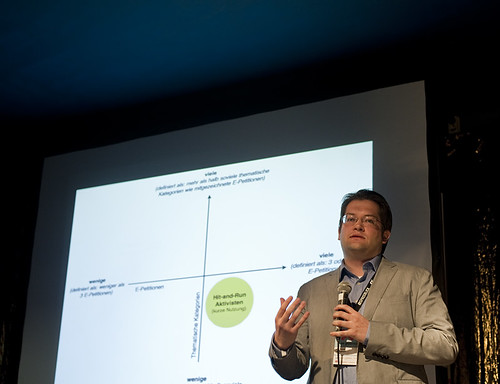
(cc) Jonas Fischer/re:publica
Am Donnerstag hielt ich einen Vortrag mit dem Titel “Politische Klicks: Nutzungsdynamik des deutschen E-Petitionssystems“. In dem Vortrag stellte ich die Ergebnisse einer Studie von Pascal Jürgens und mir zu Nutzerverhalten auf der E-Petitionsplattform des Deutschen Bundestags vor. Hier die Präsentation:
You are currently viewing a placeholder content from Default. To access the actual content, click the button below. Please note that doing so will share data with third-party providers.
Wer an mehr Informationen zu der Untersuchung interessiert ist wird bei dem Open Access Journal Policy & Internet fündig. Dort haben Pascal Jürgens und ich die Ergebnisse ausführlich in dem Artikel “The Political Click: Political Participation through E-Petitions in Germany” dokumentiert.
You need to load content from reCAPTCHA to submit the form. Please note that doing so will share data with third-party providers.
More InformationYou are currently viewing a placeholder content from Turnstile. To access the actual content, click the button below. Please note that doing so will share data with third-party providers.
More Information