What's new?

Read Blog

New Publication: A Source Like Any Other? Field and Survey Experiment Evidence on How Interest Groups Shape Public Opinion

New article out in Journal of Communication with Alexander Wuttke, Matthias Mader, and Harald Schoen: “A Source Like Any Other? Field and Survey Experiment Evidence on How Interest Groups Shape Public Opinion“.

Interest groups increasingly communicate with the public. But we know little about how effective they are in shaping opinions.

We know a lot about persuasion by political parties or high-profile candidates. But interest groups are different from these actors as they are typically much less well known. Now, how does this impact their role as communicators with the public?

When we examine persuasion, we expect that people have ways to assess the source of information (such as a parties or interest groups) and that they use this assessment in engaging with or processing messages.

As a consequence, political communication generally expects low persuasive effects of messages as people 1) mainly engage with messages by sources they support and 2) discard messages received by sources they are critical of.

But given the low public profile of interest groups, can we expect the same dynamics to hold for their persuasive appeals? We argue no and test this reasoning in two experiments.

First, we tested whether a message by a German business group with a low public profile increased support for an advocated economic policy. We tested this in a parallel survey and field experiment with three survey waves (N = 4,659). The message increased the salience of the policy, persuaded recipients of the advocated position, and increased accessible supporting considerations. Effects were modest in size and decayed over a week. Attitudes toward the interest group did not moderate the persuasive effect.

Then, we examined whether people were able to assess the credibility of ten environmental groups and six political parties in Germany (N = 700). More respondents were unable to express credibility assessments for the interest groups than for the political parties.

Finally, in a high-powered, preregistered survey experiment (N = 8,245) we tested directly whether credibility assessments affected the persuasive appeal by interest groups to the same degree as that by parties. In this final experiment, we focused on environmental groups and a message in support of energy efficient housing. Source credibility did not moderate the persuasive effect of a message attributed to a low-profile environmental group. But credibility assessments did moderate persuasive effects of the same message when we attributed it to a party. As expected, people who considered the party as a credible source on environmental issues changed their attitudes in line with the party’s message, but those who found the party not credible moved away from the advocated position.

These findings have important implications for the impact of interest group communication. As most people have no or inconsequential prior attitudes toward these low-profile sources, interest groups may neither hope for a boost in nor need fear a penalty against persuasiveness.

In this respect, their interventions appear to differ from those of actors with higher public profiles, such as parties and government representatives. The absence of credibility moderation does not imply, of course, that interest groups are generally more effective communicators.

However, whereas the persuasiveness of party communication is confined to segments of the population that are open to messages from these parties and may even have detrimental effects on others, many interest groups have the potential to address the entire public successfully.

Low-profile information sources of many different sorts are a consistent feature of contemporary communication environments, such as the wide variety of “alternative” sources challenging scientific and governmental bodies with respect to Covid-19. If messages by these sources follow the same patterns, high-profile sources such as governmental organizations face a considerable challenge in reaching doubters while low-profile sources such as alternative information providers can count on broad reach across populations.

As new groups engage in communication campaigns to shape public opinion, understanding their role as public communicators becomes important. This means accounting for their specific characteristics to understand their persuasive appeal and influence in public opinion formation.

So, if this is of interest to you have a look at the abstract or check out the article.

Abstract: Interest groups increasingly communicate with the public, yet we know little about how effective they are in shaping opinions. Since interest groups differ from other public communicators, we propose a theory of interest group persuasion. Interest groups typically have a low public profile, and so most people are unlikely to have strong attitudes regarding them. Source-related predispositions, such as credibility assessments, are therefore less relevant in moderating effects of persuasive appeals by interest groups than those of high-profile communicators. We test this argument in multiple large-scale studies. A parallel survey and field experiment (N = 4,659) establishes the persuasive potential of low-profile interest groups in both controlled and realistic settings. An observational study (N = 700) shows that substantial portions of the public are unable to assess interest group credibility. A survey experiment (N = 8,245) demonstrates that credibility assessments moderate the impact of party but not interest group communication.

Andreas Jungherr, Alexander Wuttke, Matthias Mader, and Harald Schoen. 2021. A source like any other? Field and survey experiment evidence on how interest groups shape public opinion. Journal of Communication 71(2): 276-304. doi:10.1093/joc/jqab005

New publication: Disinformation and the Structural Transformations of the Public Arena

New journal article with Ralph Schroeder in Social Media + Society on “Disinformation and the Structural Transformations of the Public Arena: Addressing the Actual Challenges to Democracy”.

Empirical studies consistently show that disinformation on digital media is best understood as a marginal phenomenon regarding reach and causal effects. See for example this instructive Twitter-thread by Hugo Mercier.

Why then does disinformation feature so strongly in the public imagination? We argue that this is a moral panic driven by pervasive but ill-understood transformations of the public arena. Unfocused fears converge on digital deviances du jour but miss underlying transformative shifts.

Focus on disinformation as a digital phenomenon endangering democracy mistakes contemporary conflicts in Western democracies for problems of information quality instead of resulting from deep underlying tensions.

In our article, we instead focus on structural transformations of the public arena and their consequences for democracy:

1. The structural weakening of gatekeepers of the public arena means that elites and publics have come to grip with an open and unruly public arena without following the temptation to automatically delegitimize challenges to the political status quo. At the same time, this raises the importance to establish and continuously maintain the legitimacy and economic basis of institutions democracies rest on in the face of mounting public challenges

2. US-based platforms are important institutions shaping the flow of political information, discourse, and contestation in many Western democracies. As a consequence, they have to accept greater degrees of scrutiny and regulation by international actors while providing greater transparency regarding access, amplification, and moderation of information flows.

3. Digital media also increase the mutual tethering of political elites and publics. Elites try to understand publics through their digital traces. At the same time, their presences of digital media make them visible and reachable for publics. This mutual tethering introduces new biases in the perception of elites and publics that might contribute to polarization or sense of political disconnect and crisis.

4. Finally, in a high-choice media environment, citizens must take on more responsibility for being well-informed, seeking out reliable and diverse sources of information, and supporting a diverse and critical public arena as a means of active political participation.

These structural shifts begin to feature in research but are far from comprehensively understood or discussed in public. But without understanding these processes and their consequences better, we will not be able to address the structural challenges to democracies.

More on how to do this is coming up in autumn, when Ralph and I address these questions in greater detail in a new book Digital Transformations of the Public Arena upcoming with Cambridge University Press.

Until then have a look at the abstract or check out the article.

Abstract: Current debate is dominated by fears of the threats of digital technology for democracy. One typical example is the perceived threats of malicious actors promoting disinformation through digital channels to sow confusion and exacerbate political divisions. The prominence of the threat of digital disinformation in the public imagination, however, is not supported by empirical findings which instead indicate that disinformation is a limited problem with limited reach among the public. Its prominence in public discourse is instead best understood as a “moral panic.” In this article, we argue that we should shift attention from these evocative but empirically marginal phenomena of deviance connected with digital media toward the structural transformations that give rise to these fears, namely those that have impacted information flows and attention allocation in the public arena. This account centers on structural transformations of the public arena and associated new challenges, especially in relation to gatekeepers, old and new. How the public arena serves actually existing democracy will not be addressed by focusing on disinformation, but rather by addressing structural transformations and the new challenges that arise from these.

Andreas Jungherr and Ralph Schroeder. 2021. Disinformation and the Structural Transformations of the Public Arena: Addressing the Actual Challenges to Democracy. Social Media + Society 7(1): 1-13. doi:10.1177/2056305121988928

New podcast with Gonzalo Rivero and Daniel Gayo-Avello on “Retooling Politics”

For “Comunicación & Política” the podcast of the Spanish Asociación de Comunicación Política (ACOP) Gonzalo Rivero and Daniel Gayo-Avello speak with by Paco Seoane Pérez about our book “Retooling Politics“. If you speak Spanish, make sure to have a listen.

Show Notes: Gonzalo Rivero (Westat) y Daniel Gayo-Avello (Universidad de Oviedo) son dos de los tres co-autores del libro ‘Retooling politics: How digital media are shaping democracy’ (Cambridge University Press, 2020). En esta entrevista reflexionan en voz alta sobre cómo ha cambiado la política desde el advenimiento de la era digital. La co-directora de la revista de ACOP, Verónica Crespo, repasa los contenidos de la publicación en su edición del mes de noviembre, que se abre con un artículo sobre política pop.

Syllabus: Gesellschaftliche Kommunikation und Öffentlichkeit

Dieses Wintersemester unterrichte ich an der Universität Jena ein Master-Seminar zu den Effekten digitaler Medien in Kommunikation und Öffentlichkeiten.

Kursbeschreibung: Das Modul gibt einen vertieften Einblick in die Geschichte, Begriffe, Theorien und Methoden an der Schnittstelle zwischen digitaler Kommunikation gesellschaftlicher Kommunikation und Öffentlichkeit. Hierbei werden technisches Design, menschliche Nutzungsmuster und wechselseitiger Einfluss von digitaler Kommunikation, Öffentlichkeiten und Gesellschaft in Hinblick auf ihre Auswirkung auf Politik und gesellschaftliche Kommunikation diskutiert. Entsprechende Themen werden vor dem Hintergrund aktueller, internationaler Fallbeispiele verdeutlicht.

  • [Syllabus]
  • “Retooling Politics” internationally available!

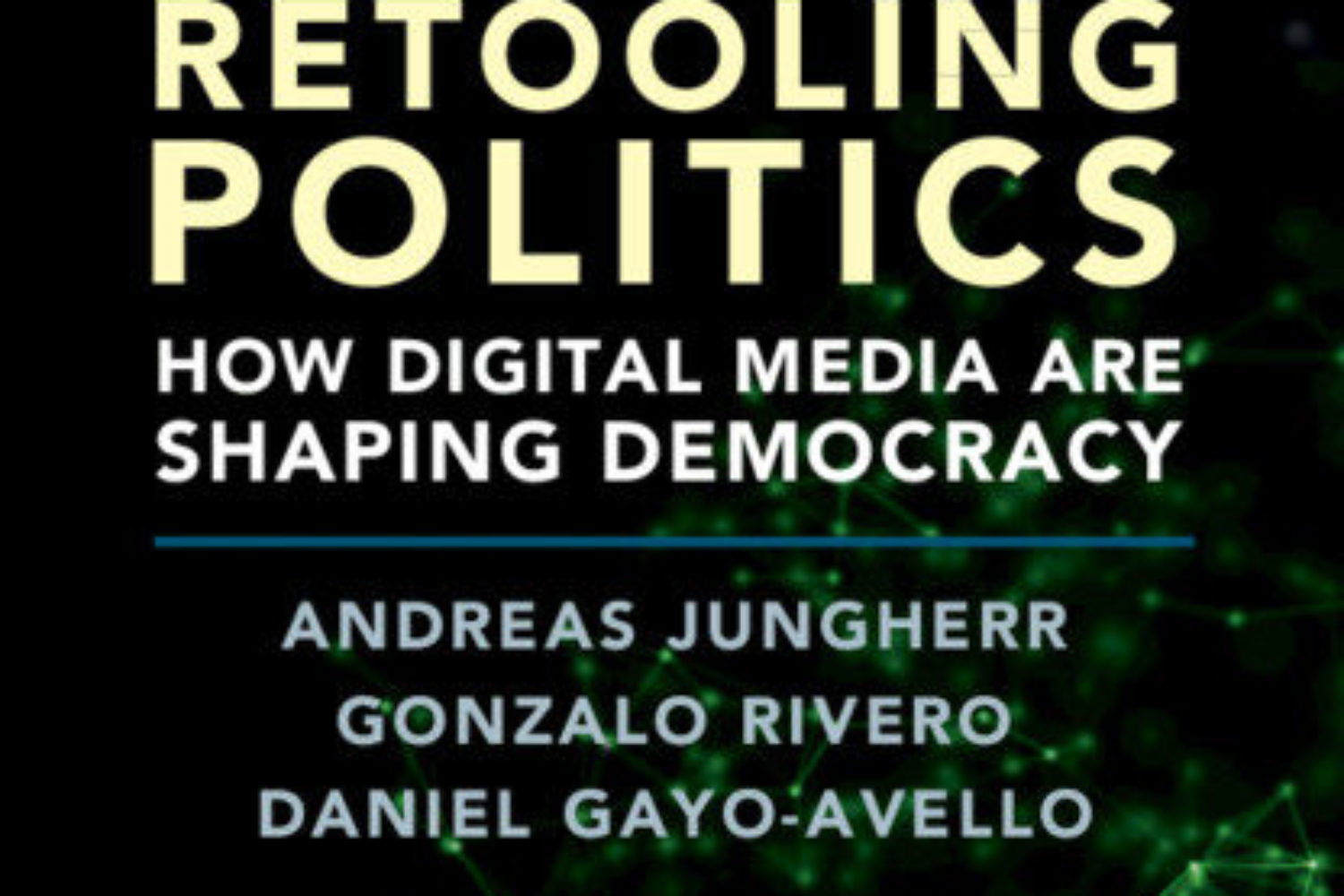
    Finally, “Retooling Politics: How Digital Media Are Shaping Democracy” is also available internationally!

    In Retooling Politics Gonzalo Rivero, Daniel Gayo-Avello, and I examine how digital media impact politics. We offer alternatives to accounts that claim digital media fundamentally transform political power and those that consider politics completely untouched by digital media

    We do not focus on digital media’s supposed effects – transformation, revolution, ineffectiveness, or democratic decline. Instead, we present the impact of digital media on six areas and tasks.

    Digital media are changing the structure of information spaces. Gatekeepers are weakened and established business models for news media are damaged. This changes availability and flows of political information as well as the possibilities for and actions of political actors.

    Digital media are changing the ways in which political actors reach people. Indirect reach via traditional media and partners is weakened but supplemented by new intermediaries – such as digital platforms – and direct reach by political actors.

    Digital media have effects on recipients. However, these are rather small and depend on usage motives and contexts. Yet, only by taking these into account we can develop a broader understanding of contemporary media effects.

    Digital media make it easier for people to coordinate. This explains their important role in protests, social movements and newly formed parties. However, this presupposes an already existing willingness to cooperate. In this, the contribution of digital media is limited.

    Success for outsiders in coordination and communication via digital media has weakened traditional organizations. Organizations, however, remain important for articulating and realizing political interests. Not least since digital alternatives show a high degree of fragility.

    Data help political actors in the pursuit of their goals. Be it in campaigning or controlling populations, data is important and helpful. But is everything that counts actually measured and does everything that is measured actually count?

    In all these fields, digital media are changing everyday politics decisively. However, this does not mean that all political power structures are suddenly turned upside down or that everyone suddenly becomes politically involved.

    Filling democracy with live and opening it to new voices is just as difficult today as it was in the past. Digital media do not change the way politics is done. As a result, extreme expectations of both optimists and pessimists will not materialize.

    While optimists expect democracy to be strengthened through greater participation, pessimists assume that it is weakened through manipulation and social division. Here, some seem to expect too much from citizens and others too little.

    We discuss all of this and much more in our book. This goes for echo chambers, filter bubbles, microtargeting, Cambridge Analytica, Obama, Trump, and Brexit.

    Anyone interested but not quite ready to commit to a book, have a listen to the Social Media and Politics Podcast where Michael Bossetta and I discuss the book, digital campaigning, data-driven politics, and do our best to bust some myths.

    You are currently viewing a placeholder content from Default. To access the actual content, click the button below. Please note that doing so will share data with third-party providers.

    More Information

    Given the current Covid-situation, we unfortunately won’t be able to personally present the book at a venue near you. But we are of course happy to join you for remote talks or in courses with topical relevance.

    Retooling Politics on the Social Media and Politics Podcast

    Michael Bossetta was kind enough to invite me on this podcast Social Media and Politics to chat about Retooling Politics: How Digital Media are Shaping Democracy. We cover the book, Gonzalo’s, Daniel’s and my motivations for writing it, and bust some favorite myths on the role of digital media in politics. So if this sounds like your thing, why not give it a listen.

    You are currently viewing a placeholder content from Default. To access the actual content, click the button below. Please note that doing so will share data with third-party providers.

    More Information

    And once you are at it, make sure to check out previous episodes. Michael has been at it for a while and collected a set of veritable treasures for anyone interested in digital media in politics.

    “Retooling Politics” seit heute in Deutschland verfügbar!

    Seit heute ist “Retooling Politics: How Digital Media Are Shaping Democracy” in Deutschland verfügbar!

    In Retooling Politics zeigen Gonzalo Rivero, Daniel Gayo-Avello und ich wie digitale Medien Politik verändern. Dabei bieten wir Alternativen zu Darstellungen, die digitalen Medien zwangsläufig transformativen Einfluss auf Politik und politische Macht zuschreiben und solchen, die digitale Medien für wirkungslos halten.

    Wir diskutieren die Rolle von digitalen Medien in Politik nicht von ihrem vermuteten Effekt her – Transformation, Revolution, Niedergang oder Wirkungslosigkeit – sondern von Veränderungen in 6 Arten wie Politik praktisch gelebt wird.

    Digitale Medien verändern die Struktur von Informationsräumen. Gatekeeper sind geschwächt und etablierte Geschäftsmodelle für Nachrichtenmedien beschädigt. Dies verändert die Verfügbarkeit und den Fluss pol Informationen sowie Möglichkeiten und Handeln von politischen Akteuren.

    Digitale Medien verändern Wege auf denen politische Akteure Menschen erreichen. Indirekter Reach über traditionelle Medien und Partner wird geschwächt aber ergänzt durch neue Vermittler – wie z.B. digitale Plattformen – und direkten Reach über eigene Angebote.

    Digitale Medien haben Effekte auf Empfänger. Diese sind jedoch eher klein und abhängig von Voreinstellungen und Nutzungskontexten. Dennoch müssen spezifische Kommunikationsbedingungen berücksichtigt werden. Dies kann zu einem erweiterten Verständnis von Medienwirkung führen.

    Digitale Medien erleichtern die Koordination von Menschen. Das erklärt ihre wichtige Rolle in Protesten, sozialen Bewegungen und neugegründeten Parteien. Allerding setzt dies bereits bestehenden Willen zur Kooperation voraus. Hier ist die Rolle digitaler Medien begrenzt.

    Erfolge in Koordination und Kommunikation über digitale Medien haben traditionelle Organisationen geschwächt. Organisationen bleiben jedoch weiterhin wichtig für die Artikulation und Realisierung politischer Interessen. Gleichzeitig zeigen digitale Alternativen hohe Fragilität.

    Datenbasierte Verfahren helfen pol Akteuren in der Verfolgung Ihrer Ziele. Sei es in der Kampagnenführung oder der Kontrolle von Bevölkerungen, Daten sind wichtig und hilfreich. Aber wird alles was zählt tatsächlich gemessen bzw. zählt alles was gemessen wird tatsächlich?

    Mit all diesen Entwicklungen verändern digitale Medien den alltäglichen Politikbetrieb entscheidend. Das heiß jedoch nicht, dass plötzlich alle politischen Machtstrukturen auf den Kopf gestellt werden oder dass sich jede und jeder plötzlich politisch einbringt.

    Demokratie lebendig und offen zu gestalten, ist heute genauso schwierig wie früher. Digitale Medien verändern die Ausübung von Politik nicht ihre Grundbedingungen. Dies führt dazu, dass extreme Erwartungen sowohl von Optimisten als auch Pessimisten nicht eintreffen werden.

    Während Optimisten eine Stärkung von Demokratie durch mehr Beteiligung erwarteten, gehen Pessimisten von einer Schwächung durch Manipulation und gesellschaftlicher Spaltung aus. Die einen erwarten scheinbar zu viel von Bürgerinnen und Bürgern und die anderen zu wenig.

    Das alles und noch viel mehr diskutieren wir in unserem Buch. Das gilt z.B. auch für Echo-Kammern, Filterblasen, Microtargeting, Cambridge Analytica, Obama, Trump und Brexit.